
What is a clinical case report?
A clinical case report or case series is defined as a detailed account of the health situation of one or more service users. Traditionally, the publication of case reports was associated with the field of medicine, but today they are increasingly being published in other health and social care disciplines, thereby contributing to the scientific evidence base in those fields. Although, according to the evidence pyramid this type of study provides a low level of scientific evidence, it can mark the starting point for research when dealing with unusual or novel cases.
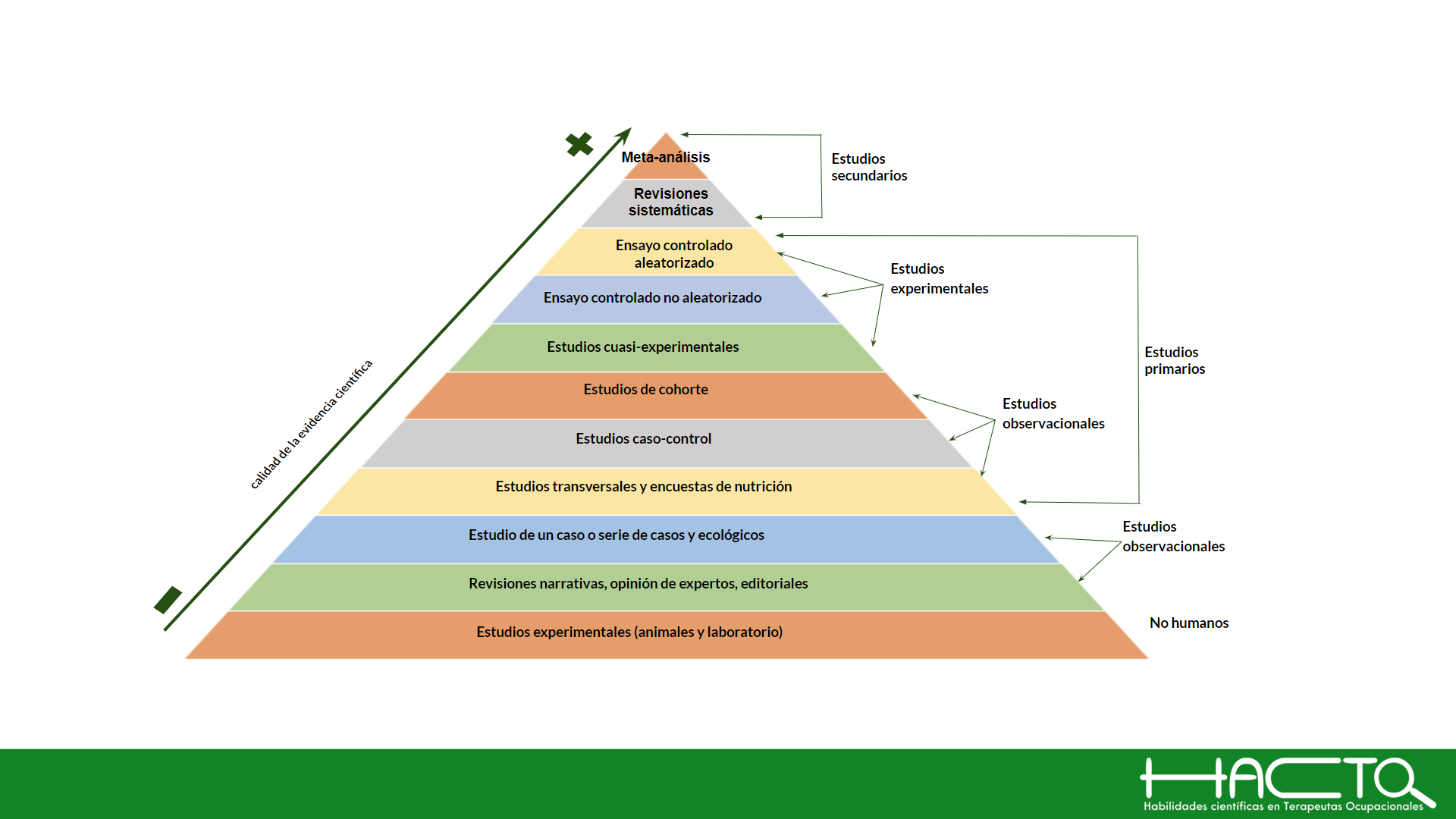
A case study involves an in-depth analysis of a phenomenon occurring within a real-world context, drawing on the collection of information to develop a thorough understanding of the case. It therefore represents an alternative methodology when studies requiring a larger sample size are not appropriate or feasible. A recent scoping review on case study research in occupational therapy found that the majority of cases had an intervention focus (87%), reporting on how and why a given occupational therapy intervention works. However, it should be noted that conclusions drawn from these cases for practice must be treated as preliminary or pilot findings, since what works for one person may not be valid for others. The remaining cases included in the scoping review contributed to the understanding of other aspects of clinical practice, such as the use of models, frameworks, and assessment tools within the occupational therapy context (1).

If you are an occupational therapist working in a clinical setting and have ever considered sharing an unusual or interesting case, you can do so through a presentation at a scientific congress or a publication in a scientific journal. Some examples of case reports published in occupational therapy include:
- Occupational Therapy Intervention in the Child with Leukodystrophy: Case Report. https://pubmed.ncbi.nlm.nih.gov/37508754/
- Intervención mediante imaginería motora tras una encefalopatía post-hipóxica. A propósito de un caso. https://www.revistatog.es/ojs/index.php/tog/article/view/226
- Effect of Play-based Occupational Therapy on Symptoms of Hospitalized Children with Cancer: A Single-subject Study. https://pubmed.ncbi.nlm.nih.gov/28503651/
If you have decided to write a scientific article, here are some preliminary considerations to help you through the process:
- Select a case that merits publication on the grounds of its originality and novelty. This originality may stem from the type of condition, an unusual co-occurrence of two conditions, the application of an innovative intervention, or other factors..
- Review the existing scientific literature beforehand to determine whether the case has previously been documented or whether any precedents exist. If a similar case has already been published, your case should not be submitted unless it offers a clearly different perspective. A summary of prior similar cases will be very useful for contextualising the existing evidence.
- For drafting the sections of the case report, we recommend using the guía CARE available on the EQUATOR Network.
- Identify and select a journal appropriate to the topic of your case and ensure the journal accepts this type of study (not all journals publish case reports). Some occupational therapy-specific options include the American Journal of Occupational Therapy (AJOT, internationa) and the Revista de Terapia Ocupacional Galicia (TOG, national). ). Journals dedicated to the publication of case reports also exist, such as Clinical Case Reports o BMJ Case Reports.

Writing the case report
Several guidelines are available for occupational therapists to assist with this process, including the one proposed by the Royal College of Occupational Therapists.
The standard sections included in an occupational therapy case report on an intervention (the most common type) are described below (2,3).
Title. The title should be concise, but must include reference to the condition or diagnosis, the main intervention, and the study type since this is a case report, the term “case report”should be included.
Authors and affiliations. As explained in the entry on authorship, all individuals who meet the following criteria may be considered authors: 1) making a substantial contribution to the conception or design of the work, or to the acquisition, analysis, or interpretation of data; 2) participating in drafting the manuscript or critically revising it for relevant intellectual content; 3) approving the final version for publication; and 4) agreeing to be accountable for all aspects of the work in terms of accuracy and integrity. It is important to always sign using the same name so that databases recognise you as the same author. Affiliation the individual’s membership of an organisation, institution, group, or entity must also be included.
Abstract and keywords. The type of abstract (structured or unstructured) and its length will be determined by the target journal. Regardless of format, the abstract should contain a summary of the introduction (study objective and rationale), description of the case (key characteristics of the service user(s) and data collection), main results, and the conclusion and/or implications for practice drawn from the case. Between 2 and 5 keywords should be included, identifying the main condition, intervention, and study type “case report”.
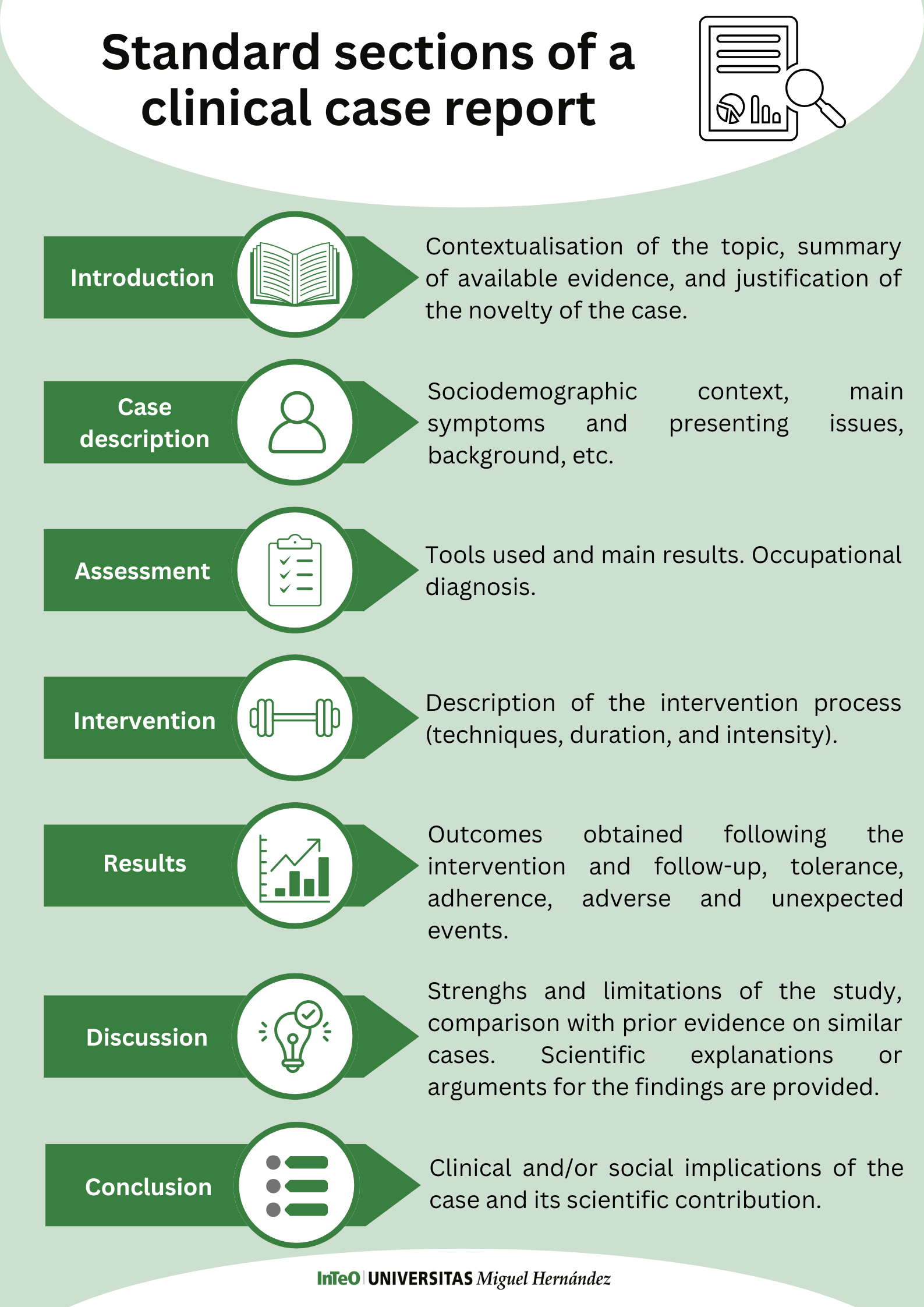
Introduction. This section contextualises the case (relevant data on the impact of the condition, such as prevalence figures or rare disease data) and provides a brief summary of previously published literature on similar cases. It should also justify why the case merits publication, what it contributes, and its implications for public health.
Case description. This section includes relevant information about the service user, such as sociodemographic data (age, sex, marital status, educational level, country of birth, etc.) and a detailed description of the condition, symptoms, and/or presentation. It may also include information on medical, family, and psychosocial background (e.g. lifestyle, substance use, previous interventions, comorbidities, etc.) to help contextualise and better understand the case.
Assessment process. A description of all tools used and the results obtained during the initial assessment of the service user. It is important to highlight that, wherever possible, tools that have been adapted and validated for the relevant population should be used, in order to ensure that the assessment results accurately reflect the service user’s actual status and are not affected by measurement error, comprehension issues, or other influencing factors. Explicit information on the occupational diagnosis, occupational performance, or functional capacity of the service user may also be included.
Intervention. A description of the type of intervention (techniques, models, and activities used) and its characteristics in terms of dose, duration, and intensity (timeline, number of sessions, etc.). Any changes that occurred during the intervention should also be described.
To facilitate and guide the data collection process during assessment and intervention, the CARE guideline has developed a flowchart outlining how data on the service user should be collected, so that it can be gathered systematically and written up in accordance with the CARE guidelines.
Results and follow-up. This section includes the outcomes obtained following the intervention (collected at reassessment) and any follow-up results (if measurements were taken at multiple time points). Information on the service user’s or group’s tolerance and adherence to the intervention, as well as any adverse or unexpected events, may also be included.
Discussion.. A summary of the main findings of the case report, highlighting the key strengths and limitations of the study and comparing the procedures carried out with prior literature on similar cases. Scientific explanations or arguments for the findings are provided.
Conclusion. The clinical and/or social implications of the case are outlined, with emphasis on its relevance and its scientific contribution to clinical practice.
References. A list of scientific articles cited throughout the text. The reference style will be determined by the target journal. To automate the referencing process, a reference manager can be used (further information on the use of reference managers can be found here). enlace).
Ethical considerations. It is of the utmost importance to obtain a signed informed consent document from the individual(s) involved in the case report or case series prior to using and publishing their data. For this type of study, ethics committee approval (an external review body that verifies that the necessary ethical standards for conducting the study are met) is increasingly required. Any conflicts of interest on the part of the authors must also be declared, along with a statement on whether the study received any public or private funding. All of this information must be included in the relevant section of the manuscript, as specified by the journal.

Supplementary material or appendices (optional). In some cases, supplementary material may be included, such as the informed consent template, copies of the assessment tools used, images, or diagrams of the intervention process.
References
- McQuaid L, Thomson K, Bannigan K. Exploring the contribution of case study research to the evidence base for occupational therapy: a scoping review. Systematic Reviews. 2023;12(1):132.
- Palisano RJ. The Case Report, Case Study, and Single Subject Design. Physical & Occupational Therapy In Pediatrics. 2007;27(4):1-5.
- Riley DS, Barber MS, Kienle GS, Aronson JK, von Schoen-Angerer T, Tugwell P, et al. CARE guidelines for case reports: explanation and elaboration document. Journal of Clinical Epidemiology. 2017;89:218-35.

Irene Campos Sánchez
Occupational Therapist, Master's in Neurological Occupational Therapy and Master's in Public Health. FPU Pre-doctoral Researcher in the PhD Program in Public Health and Medical and Surgical Sciences. Collaborator at InTeO.

Mª Paula Noce
Occupational Therapist, Master's in Neurological Occupational Therapy and Master's in Public Health.Pre-doctoral Researcher in the PhD Program in Public Health and Medical and Surgical Sciences. Collaborator at InTeO.

Translate by: Beatriz Espinosa
Occupational Therapist, holding a Master's Degree in Intervention for Functional Diversity in Childhood and specialized training in child development and mental health. University degree officially recognized in Australia.
Campos Sánchez, I., & Noce, M. P. (2024, junio 26). Clinical case reports in occupational PublicaTO – Scientific Skills in Occupational Therapy by InTeO. https://hacto.umh.es/2024/06/26/casos-clinicos-en-terapia-ocupacional/
This work is licensed under a Creative Commons Licence.
