
Scientific publication in occupational therapy is an essential step in disseminating our research findings to the professional community and/or the general public. The act of “publishing” has been described as ‘making something known and manifest to the public’, and constitutes an essential tool for the progress of the discipline (1). In a previous entry we provided more details about scientific articles, which you can read at thislink.
One of the most important aspects of publishing a manuscript is selecting the right journal. This is not a straightforward decision, and it is essential to choose carefully, as submitting a manuscript to an inappropriate journal typically results in near-immediate rejection. There are currently countless journals in which to publish, and it is important to avoid those classified as “predatory” — journals that charge authors publication fees without conducting a legitimate peer review process (further information available at this link).
Although no definitive guidelines exist that guarantee publication success, there are several factors that can help guide the journal selection process. These relate primarily to the journal (subject area, indexing, number of articles received, quality, etc.) and to the manuscript (methodological aspects, study size, relevance and novelty of findings, language, limitations, etc.)(2,3).
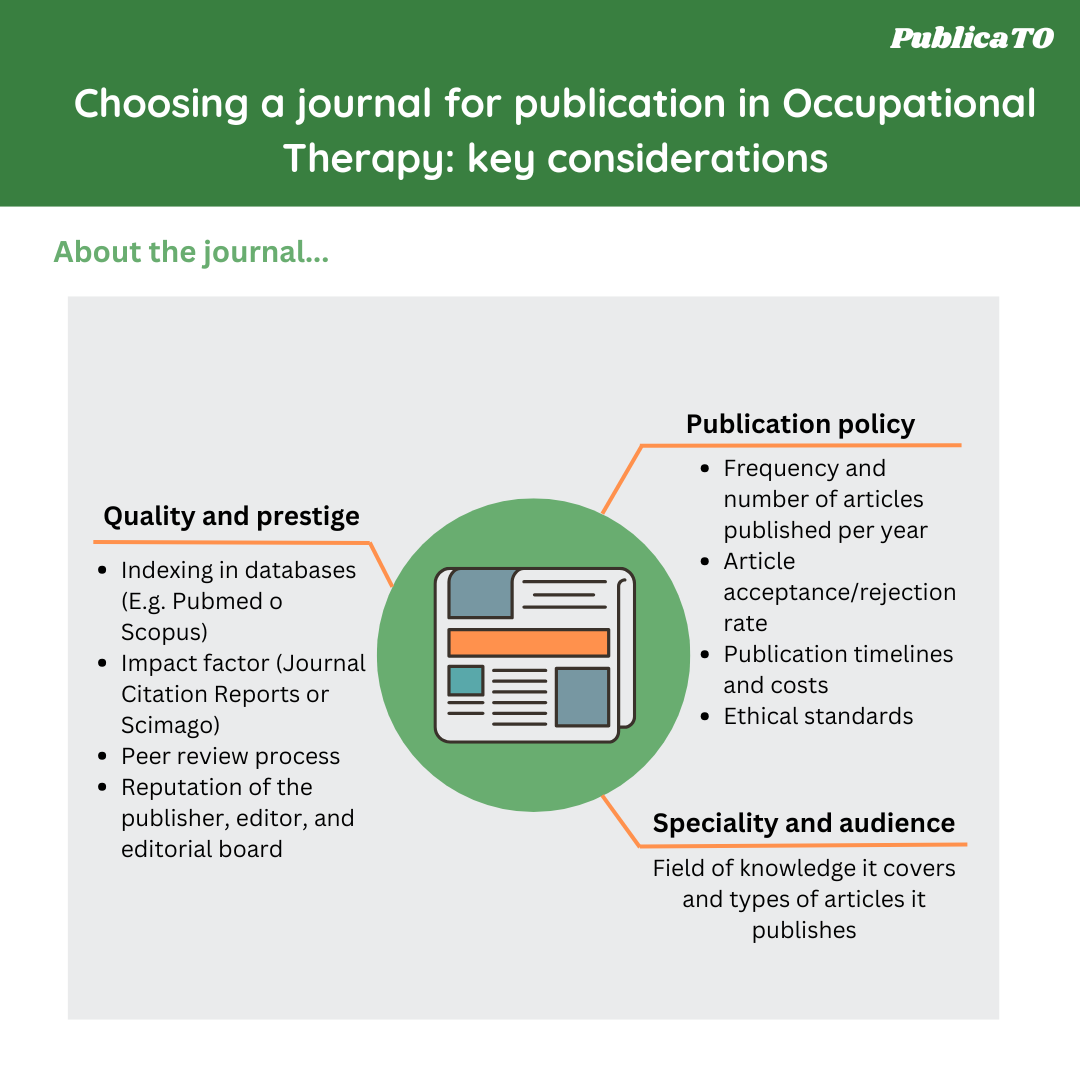
About the journal…
- Quality and prestige
If the aim is to publish in a “high-quality” journal, there are certain indicative parameters, even though these do not guarantee quality in every case.
These parameters include the journal being indexed in one of the major international databases, such as PubMed (https://pubmed.ncbi.nlm.nih.gov/), Scopus (http://scopus.com/) or Web of Science. Journals indexed in these databases are not only considered of higher quality and prestige, but also ensure the manuscript reaches a wider audience, as they appear in these widely used search engines.
The next quantitative quality indicator is the journal’s impact factor (IF).The IF is a tool that ranks the prestige or influence of a journal within its field or area of knowledge. The most widely known is the Journal Impact Factor (JIF) from the Journal Citation Reports (JCR) (https://jcr.clarivate.com/jcr/home). The JCR is a tool included in the Web of Science platform by Clarivate Analytics; the impact factor is calculated based on the number of citations received and the total number of items published in the journal over the preceding two years (further information available at this link). However, this is not the only citation metric in use. The Scimago Journal Rank (SJR) from the Scimago database (https://www.scimagojr.com/) is also widely used and includes journals indexed in Elsevier’s Scopus. This indicator differs from the JIF in that it covers the preceding three years and additionally weights citations according to the SJR of the citing journal (further information available at this link). Journals ranked in the first quartile (Q1) are within the top 25% of journals ordered by impact factor, and therefore represent the most competitive venues for publication.
It is also important to consider the journal’s peer review process, as this guarantees the quality and validity of published work. Other factors to consider include the reputation of the publisher, the editor, and the editorial board (in relation to the journal’s subject area).
- Publication policy
Another key aspect is the journal’s publication frequency, that is how often it publishes (annually, biannually, quarterly, monthly, etc.) and the number of articles published per year. The more issues published per year, the greater the likelihood of the manuscript being accepted. Some journals also provide their acceptance rate (percentage of submitted manuscripts that are published) or rejection rate (percentage that are rejected), which can offer useful insight into the likelihood of acceptance. It is also important to check the journal’s estimated publication timelines, taking into account the time from acceptance to final publication.
The remaining factors to consider are the cost and ethical standards of publication. Publishing in open access journals typically involves a financial cost for authors, covering article processing charges (peer review, formatting, etc.). Some journals also apply additional fees depending on length (number of pages), inclusion of colour figures, or exceeding the maximum number of references, among other factors. The journal should also explicitly describe the ethical principles underpinning its operations, including clear manuscript submission guidelines, co-author approval procedures, ethics committee approval, and conflict of interest declarations.
- Journal speciality and audience
The potential journals for publication will depend on the type and subject matter of the manuscript. For example, if an occupational therapy intervention study has been conducted with a paediatric population, the first choice might be to submit to a journal that publishes in this area of knowledge (e.g. Physical & Occupational Therapy in Pediatrics). It is also worth reviewing the types of manuscripts and topics the journal accepts in order to maximise the likelihood of acceptance. To do this, consult the Instructions for Authors and review the most recently published articles.
Example: “Physical & Occupational Therapy in Pediatrics accepts the following types of article: original research article, perspective, systematic review, meta-analysis, scoping review, case report or case series, and commentary.”
About the manuscript…
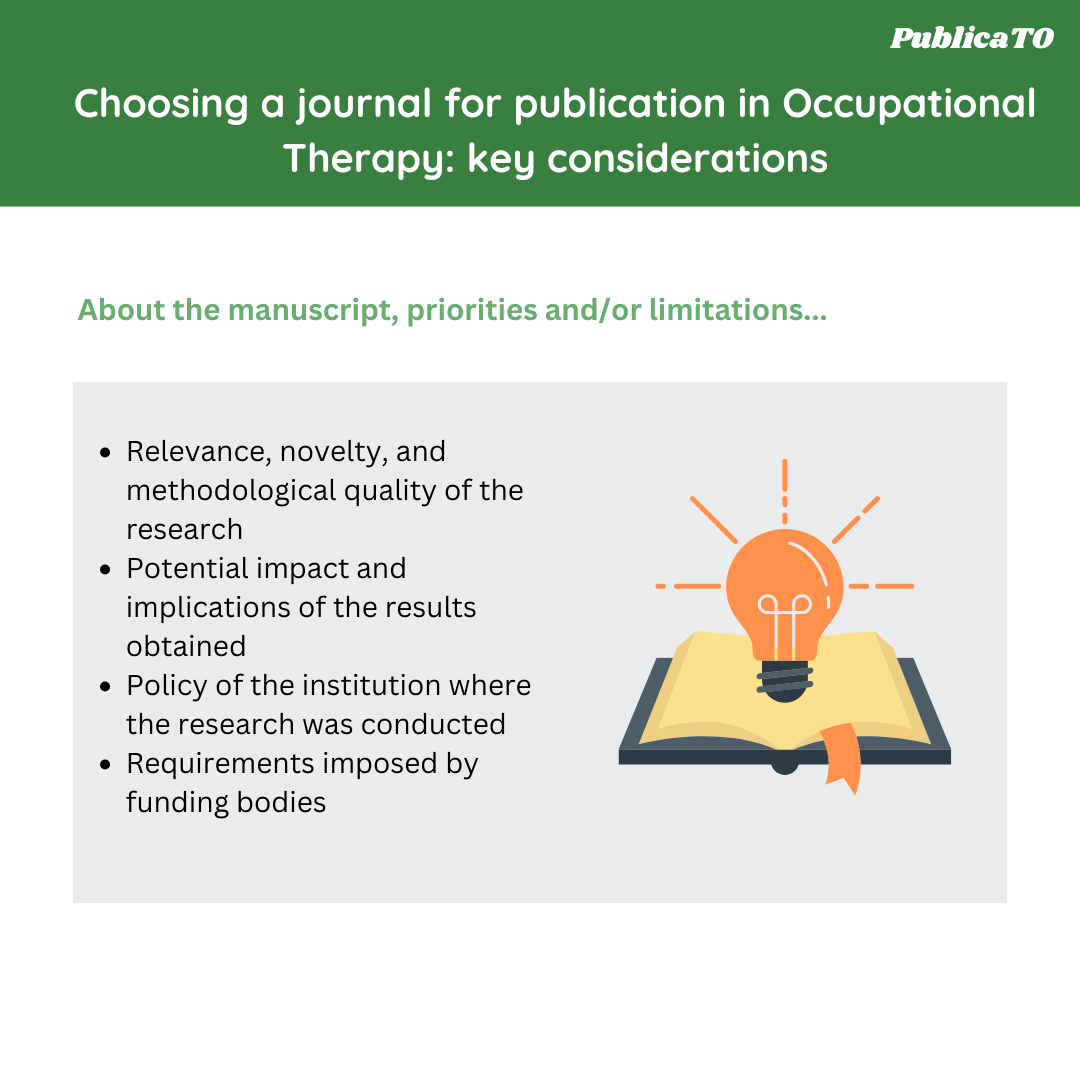
If a manuscript is relevant, novel, and has followed an appropriate methodology, it has a greater chance of being published. Furthermore, if the findings have implications or applications for population health or health and social care policy, it may be possible to target higher-impact journals. It is also important to consider whether the choice of journal is already determined by the publication policies of the institution conducting the study, or by the requirements of funding bodies.
Below is a list of journals that include the words “occupational therapy” in their title, which may be of help:
Included in the Journal Citation Reports:
- Occupational Therapy International
- Occupational therapy in health care
- Occupational Therapy in Mental Health
- Occupational Therapy Journal of Research
- Australian Occupational Therapy Journal
- Physical & Occupational Therapy in geriatrics
- Physical & Occupational Therapy in pediatrics
- Journal of Occupational Therapy Schools and Early Intervention
- British Journal of Occupational Therapy
- American Journal of Occupational Therapy
- Canadian Journal of Occupational Therapy-Revue Canadienne d Ergotherapie
- Hong Kong Journal of Occupational Therapy
- Scandinavian Journal of Occupational Therapy
- Cadernos Brasileiros de Terapia Ocupacional-Brazilian Journal of Occupational Therapy
Included in Scimago but not in the JCR:
Journals that publish in Spanish:
- Revista Terapia Ocupacional Gallega (TOG)
- Revista Chilena de Terapia Ocupacional
- Revista Ocupación Humana
- Revista Argentina de terapia ocupacional
- Revista Puerto Rico de Terapia Ocupacional
- Revista Contexto
Other options:
- Asian Journal of Occupational Therapy
- New Zealand Journal of Occupational Therapy
- Annals of International Occupational Therapy
- Journal of Acute Care for Occupational Therapy
- Journal of Occupational Therapy at the University of Sao Paulo/Revista de Terapia Ocupacional da Universidade de São Paulo
- Journal of Occupational Therapy Education
- Journal of the Occupational Therapy Society/職能治療學會雜誌
- Open Journal of Occupational Therapy
- South African Journal of Occupational Therapy
References:
-
- Rawat S, Meena S. Publish or perish: Where are we heading? J Res Med Sci. 2014;19(2):87-9.
- Bahadoran Z, Mirmiran P, Kashfi K, Ghasemi A. Scientific Publishing in Biomedicine: How to Choose a Journal? Int J Endocrinol Metab. 2020;19(1):e108417.
- Forero DA, Lopez-Leon S, Perry G. A brief guide to the science and art of writing manuscripts in biomedicine. J Transl Med. 2020;18:425.

Irene Campos Sánchez
Occupational Therapist, Master's in Neurological Occupational Therapy and Master's in Public Health. FPU Pre-doctoral Researcher in the PhD Program in Public Health and Medical and Surgical Sciences. Collaborator at InTeO.
Translate by: Beatriz Espinosa
Occupational Therapist, holding a Master's Degree in Intervention for Functional Diversity in Childhood and specialized training in child development and mental health. University degree officially recognized in Australia.
