
Do you know the Cochrane Network?
In the following entry we tell you more about the platform and the useful tools it offers for your professional practice as a clinician and/or researcher.
Cochrane is an international non-profit network based in the United Kingdom. The platform was created with the aim of improving knowledge and decision-making on health topics for anyone with an interest in the field (clinical professionals, patients, carers, researchers, etc). With this goal in mind, the Cochrane Network has three key objectives: 1) to produce reliable and timely summarised evidence that addresses the most important questions in health and healthcare, 2) to advocate for evidence, and 3) to promote informed health decision-making.
What can we find on Cochrane?
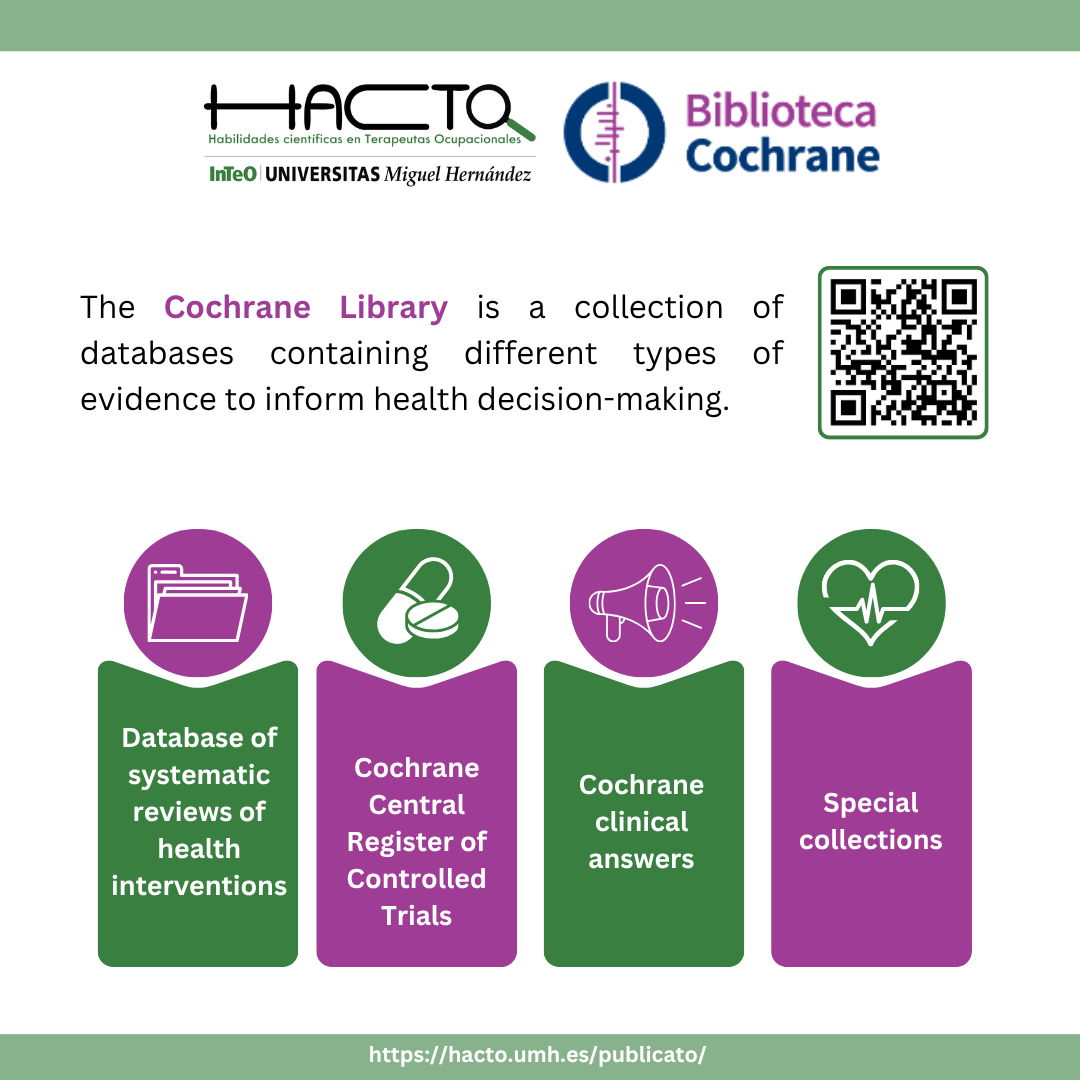
In addition to the Cochrane Library (a collection of databases containing independent evidence to inform health decision-making), the Cochrane Network also offers training services and software tools that support users in conducting systematic reviews.
COCHRANE LIBRARY
The Cochrane Library section integrates the following databases:
- Cochrane Database of Systematic Reviews. This database includes systematic reviews of health interventions, review protocols, and editorials.
- Cochrane Central Register of Controlled Trials (CENTRAL).
- Cochrane Clinical Answers.
- Special Collections.
Below is an example of a search that could be conducted using the library’s search engine. First, the preferred language for both the reviews and the website can be selected. If we wished to find systematic reviews related to “occupational therapy” AND “stroke”, we would enter these keywords in the search bar on the right-hand side.


As shown in the image, the search was conducted using the “Title, abstract or keywords” field; however, this can be modified to specify where the keywords should be located, depending on the user’s needs (author, publication type, full text, etc.).
Running this search returns the following results (documents included in the Cochrane Library): 9 systematic reviews, 0 protocols, 995 clinical trials, and 1 clinical answer. These results can be filtered by various characteristics (year of publication, language, review type, topic, etc.) using the filters on the left-hand side of the platform. This demonstrates how the library integrates its different databases into a single search.

COCHRANE JOURNAL
In addition to the Cochrane Library, the network has its own journal: Cochrane Evidence Synthesis and Methods. This open-access journal contains evidence on how different types of literature reviews are produced and published. It covers various types of evidence synthesis in the health and social care field, including scoping reviews, rapid reviews, evidence gap maps, brief reports, and methodological research evaluating how evidence syntheses are planned, produced, and disseminated. The journal also welcomes research articles that seek to document and develop evidence synthesis decisions and methods, such as prioritisation, consumer involvement, and meta-research aimed at improving research integrity.
PLAIN LANGUAGE SUMMARIES AND PODCASTS
In order to reach all interested audiences, Cochrane has developed Plain Language Summaries and Cochrane Podcasts. All Cochrane reviews include a summary written in a standard, plain language format that facilitates comprehension and interpretation of the research findings for any reader. Cochrane Podcasts offer a brief summary (under 5 minutes) of a recent review, delivered by the authors themselves, allowing everyone to access the latest Cochrane evidence.
TRAINING IN SYSTEMATIC REVIEWS
The platform includes a training course called Cochrane Interactive Learning. This is a self-directed training course of over 10 hours covering the entire process of conducting a systematic review, designed for authors with varying levels of experience.
TOOLS TO SUPPORT THE CONDUCT OF REVIEWS
● RevMan Web: acilitates the preparation of protocols, full reviews, and meta-analyses (including text, study characteristics, comparison tables, and study data).
● Covidence: facilitates citation screening and data extraction (including risk of bias assessment). Can be used in combination with RevMan.
COCHRANE IBEROAMÉRICA
The Cochrane Iberoamerican Centre encompasses Spain and 18 other Spanish-speaking countries. This network offers training courses and a wide range of resources in Spanish. It also develops various dissemination projects and formats to bring evidence-based health to the general public and promote critical thinking, as well as resources aimed at improving the quality of health communication, with the goal of supporting better health decision-making. To foster critical thinking about interventions and treatments and support informed health decisions, a series of key points has been developed to encourage critical reading of scientific evidence. Among the available evidence dissemination resources, users can find podcasts, informational videos, infographics, blogshots (image-format cards summarising the key points of a review), and visual summaries.

Empar Casaña Escriche
Occupational Therapist, Master’s in Occupational Therapy in Neurology. FPU Pre-doctoral Researcher in the PhD Program in Public Health, Medical and Surgical Sciences. Contracted Researcher at InTeO.

Rocío Muñoz Sánchez
Occupational Therapist, Master’s Degree in Occupational Therapy in Neurology, and Master’s Degree in Public Health. Predoctoral Researcher in the PhD Program in Public Health, Medical, and Surgical Sciences. Collaborator at InTeO.

Translate by: Beatriz Espinosa
Occupational Therapist, holding a Master's Degree in Intervention for Functional Diversity in Childhood and specialized training in child development and mental health. University degree officially recognized in Australia.
