A cover letter is a document submitted to a scientific journal alongside a manuscript when seeking its possible publication. The primary purpose of this letter is to introduce the manuscript to the editor, providing a clear and concise summary of the study’s objective, its most relevant contributions, and why the findings merit publication. In this entry, we will explore each of these aspects in depth.
A cover letter is typically quite brief — generally between half a page and one full page — but plays a key role in the editorial process, as it constitutes the editor’s first impression of the submitted work and can decisively influence the course that manuscript takes, whether that means proceeding through peer review or being rejected outright.
The cover letter should justify why the article is appropriate for the journal to which it is being submitted. This involves demonstrating that the topic falls within the journal’s scope and that the content will be relevant to its readership. To this end, it is advisable to consult the journal’s aims and scope on its website. The letter typically also includes a statement regarding the originality of the work, confirming that it has not been previously published and is not currently under consideration by another journal. In addition, potential reviewers may be suggested, or conflicts of interest disclosed, as required by the journal.
As the above makes clear, it is important to draft the cover letter with the same care and rigour as the rest of the manuscript, as it forms an essential part of the submission and publication process. If you would like to learn more about the sections of a scientific article, you can access the following link.
What should my cover letter include? What is its structure?
It should be noted that cover letters do not always need to include the same information or follow a fixed structure — this depends on the specific requirements of each journal. Before drafting your letter, we therefore recommend consulting the Instructions for Authors of the journal to which you intend to submit your manuscript. That said, in general terms, a cover letter typically follows the structure outlined below.
Heading and salutation
- The letter should be addressed to the editor-in-chief or the associate editor responsible for the relevant subject area. It is advisable to use a personalised salutation such as “Dear Dr. [Surname].” The editor’s name can usually be found on the journal’s website under the Editorial Board section.
- The title of the manuscript, the article type (original research, review, etc.), the names of all authors, and the intention to submit to the journal should be stated explicitly.
Introduction to the manuscript and summary
- This is the central section of the letter. It should include a concise summary of the research purpose or objective, the general methodology employed (study design), the most relevant results, and the main conclusions. It should also highlight why the work is novel or significant, how it contributes to the field, and why it is relevant to the journal’s readership. This section should not be a copy of the article’s abstract, but rather a brief editorial interpretation of it. Remember that the cover letter as a whole should not exceed one page.
Justification for the chosen journal
- A key element is explaining why this particular journal was selected. Mentioning thematic alignment, methodological focus, or even previously published studies in the journal that relate to the manuscript can strengthen this justification. This demonstrates that the author has researched the journal’s editorial focus and has not submitted at random.
- Highlighting the potential future implications of the article — whether clinical or research-related — can be highly relevant.
Formal declarations
- At the end of the letter, formal declarations of originality, non-duplicate submission, and approval by all co-authors should be included. In some cases, it may also be necessary to state whether ethical approval was obtained for the study, whether responsible research guidelines have been followed, and whether any conflicts of interest exist.
Signature and contact details
- The letter should close with a courteous closing formula accompanied by the contact details of the corresponding author, including full name, institutional affiliation, and email address.
- Including a brief acknowledgement of the editor’s time and consideration can add a professional and cordial touch.
In summary, the letter should be clear, concise, and professional, and should not exceed one page in length — though it is always advisable to check the journal’s instructions.
Common mistakes to avoid
Writing an effective cover letter also means avoiding certain mistakes that can negatively affect the editor’s perception of the manuscript. One of the most frequent errors is writing a generic or poorly personalised letter. Although all cover letters share a similar structure and content, they must be tailored to the journal in question — for example, by including the editor-in-chief’s surname in the salutation or referencing a specific aspect of the journal. We recommend browsing the journal’s recent issues to review the types of manuscripts published and to identify whether particular aspects are given special emphasis. Do not expect to find a sample cover letter in the journal itself — these letters are not published.
The excessive use of technical terminology or overly complex language can hinder quick comprehension of the article and should therefore be avoided, while always maintaining a professional register. Overstating the importance of the study is also something to be avoided.
Another common mistake is writing an excessively long or repetitive letter — brevity and clarity are what matter. Additionally, failing to include the required ethical statements or not verifying the correct name of the editor can create a poor first impression.
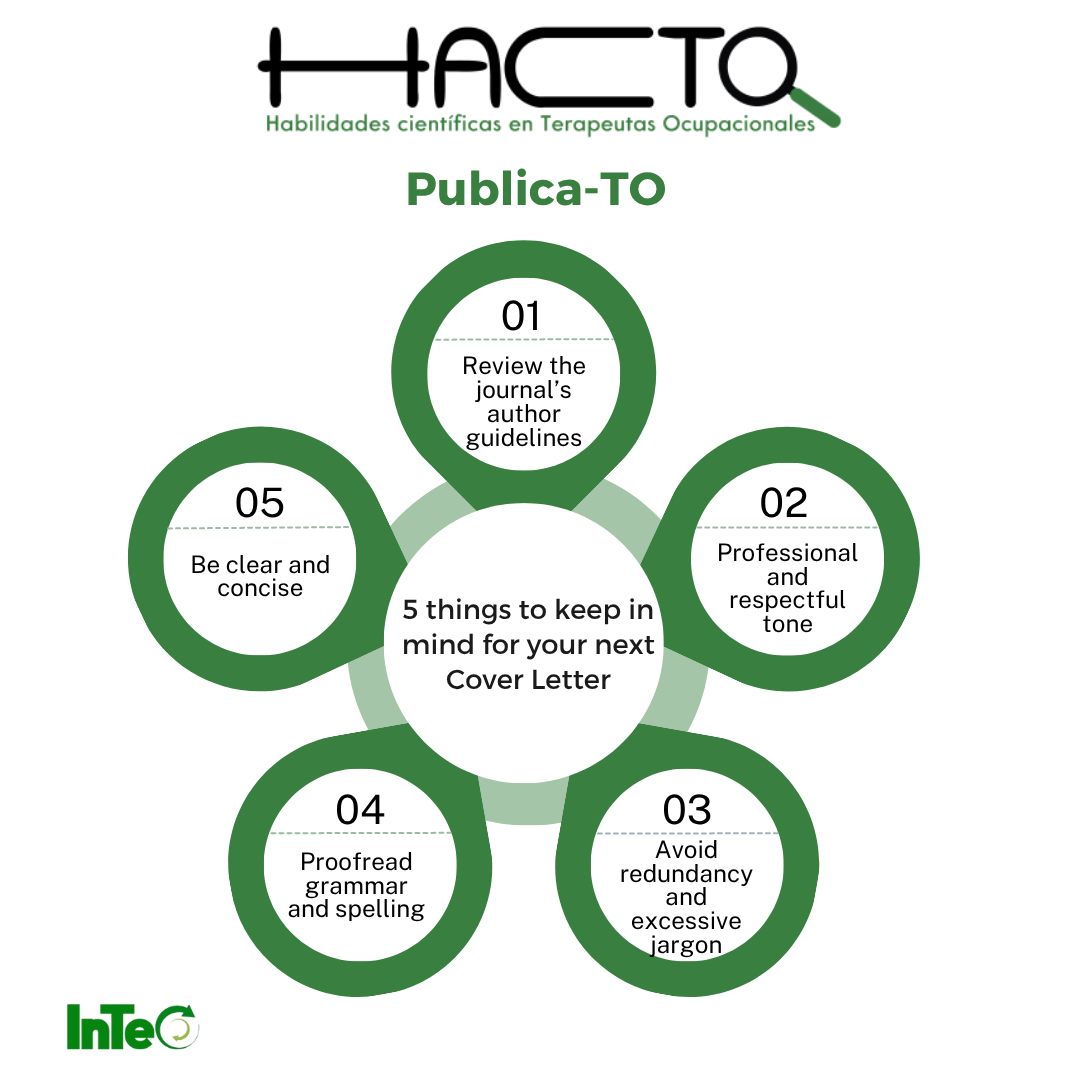
Five tips to help your cover letter make a good impression
- Review the Instructions for Authors and follow the guidelines specified by the journal.
- Maintain a professional and respectful tone (avoiding excessive technical jargon).
- Avoid redundancy — include only the key information needed to make your manuscript appealing.
- Proofread carefully before submitting.
- Be concise and direct.
In summary, the cover letter is a document of professional and strategic communication that allows authors to introduce themselves to the editor, position their work attractively, and increase the likelihood that the manuscript will be accepted for peer review. We therefore recommend that, once the article has been completed, sufficient time is also dedicated to writing the cover letter.

Rocío Muñoz Sánchez
Occupational Therapist, Master’s in Neurological Occupational Therapy and Master’s in Public Health.Pre-doctoral Researcher in the PhD Program in Public Health and Medical and Surgical Sciences. Collaborator at InTeO.

Lorena Chaves
Occupational Therapist, Master's in Neurological Occupational Therapy. Collaborator at InTeO.

Translate by: Beatriz Espinosa
Occupational Therapist, holding a Master's Degree in Intervention for Functional Diversity in Childhood and specialized training in child development and mental health. University degree officially recognized in Australia.
Muñoz, R.,& Chaves, L. (2025, 3 de diciembre). What is a cover letter? PublicaTO – Habilidades Científicas en Terapia Ocupacional de InTeO. https://hacto.umh.es/en/2026/07/28/what-is-a-cover-letter/
This work is licensed under a Creative Commons License