
Your manuscript is written , but what do you need to do next in order to submit it to a scientific journal for publication.
- Choosing the journal – adapting the manuscript
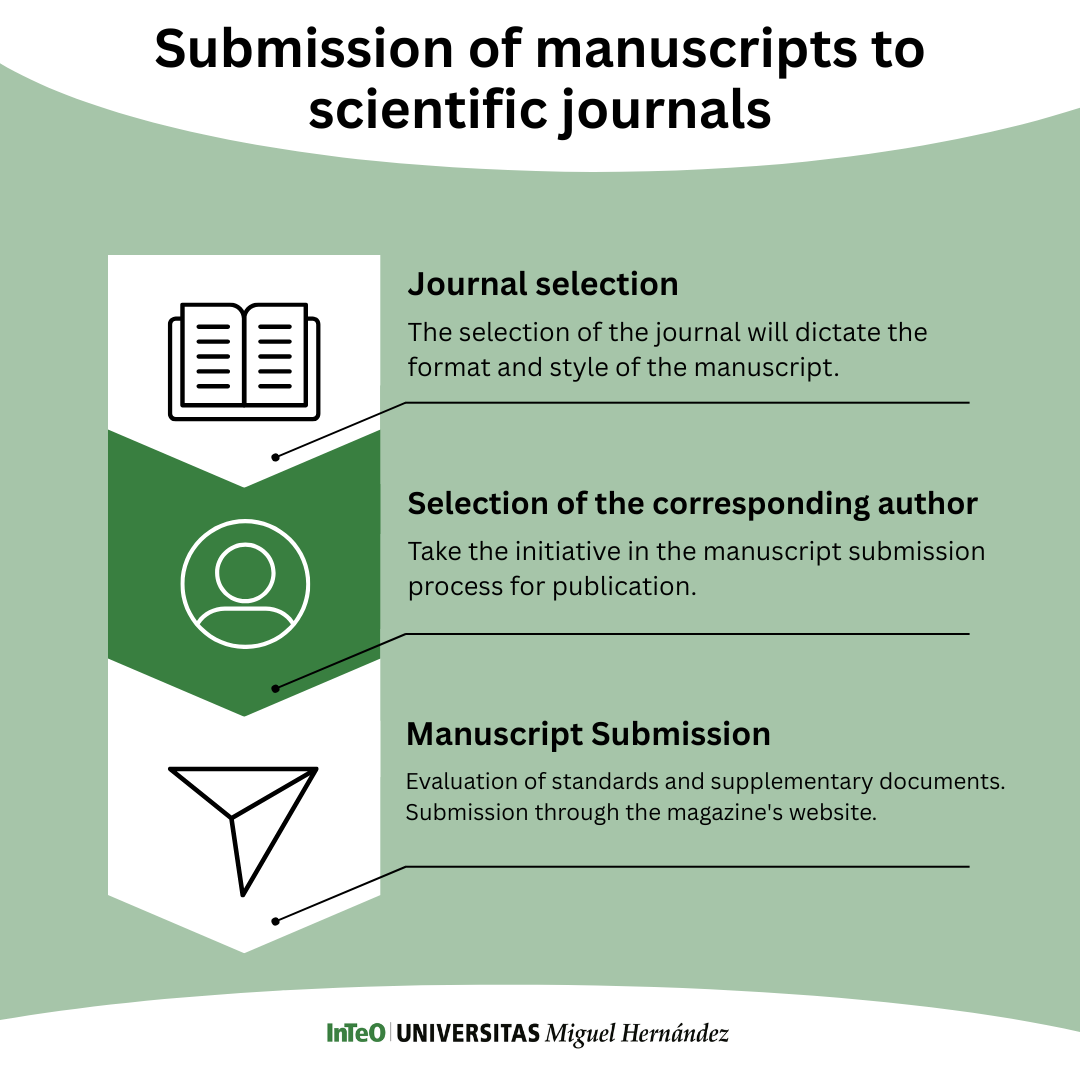
Choosing the journal in which to publish your manuscript is one of the most important decisions in the process, as it will determine the subsequent steps for submission. When choosing a journal, the following aspects should be taken into account: the estimated publication timelines, whether the article fits the journal’s subject area or scope, the journal’s impact, and other relevant factors. These aspects are discussed in more detail in a previous entry.
Once the target journal has been selected, its publication guidelines must be reviewed. It is necessary to adapt the manuscript to each journal’s specific requirements and recommendations. All journals include a section on their website – typically labelled “Information or Guidelines for Authors” or “Submission Guidelines” where the requirements for correct manuscript submission are detailed. Some of the guidelines and recommendations specified typically cover: manuscript formatting; figures and/or tables (maximum word and figure counts; style for table headings and footnotes, etc.); the bibliographic referencing style used by the journal (APA, Vancouver, AMA, etc.) and whether a maximum number of references applies; the required length and format of the abstract (structured or unstructured); the maximum number of authors; and other related requirements. Some journals also request that the manuscript be structured into specific sections, or use different names for standard sections (e.g. “Methods” or “Methodology”).
To better understand these requirements, it is helpful to visit the Author Guidelines of the “” American Journal of Occupational Therapy (AJOT). This journal asks authors to pay attention to several aspects. It specifies the platform through which manuscripts must be submitted and where to find the guidelines, as well as how to resolve any queries that may arise during the process. Four documents are listed: two of them – the (“Copyright Transfer/Author Certification/Financial Disclosure Form” and the “Pre Submission Checklist for Authors“) must be completed prior to submission and included with the manuscript. The remaining two are guides for structuring the abstract and recommendations for systematic reviews. A further section specifies rules and recommendations regarding figures and tables. In the “Article Types, Word Limits, and Reporting Guidelines” section, two tables are provided: one describing the manuscript types and word counts, and another specifying the manuscript type and the recommended or required reporting guideline. Two additional sections address specific requirements for systematic reviews, clinical trials, and qualitative studies.
Although each journal includes different elements in its author guidelines, Although each journal includes different elements in its author guidelines, all are broadly similar. When adapting a manuscript, it can also be helpful to read several recent issues of the journal to get a sense of its general style, and to review its aims and scope carefully. To save time, it is advisable to have a target journal in mind at the start of — or during — the manuscript preparation process, so that its guidelines can be applied from the outset.
It is important to carefully review the journal’s policies, publishing guidelines, and specifications, as the number of predatory journals—those that do not meet quality standards is increasing and they should be avoided. A previous post provides information on what predatory journals are and tips for identifying them entrada. It is also advisable to use an EQUATOR Network reporting guide to ensure that no important aspect has been overlooked; some journals require authors to upload the complete checklist, indicating the page or line number where each point is addressed.
Finally, it should be noted that the first journal to which a manuscript is submitted may not be the one that publishes it — manuscripts are sometimes rejected and must be resubmitted elsewhere. Before resubmitting, all the aspects of the new journal discussed above should be reviewed carefully, since although documents and requirements are similar across journals, each one has its own specific requirements and stylistic preferences.
2) Designating the corresponding author
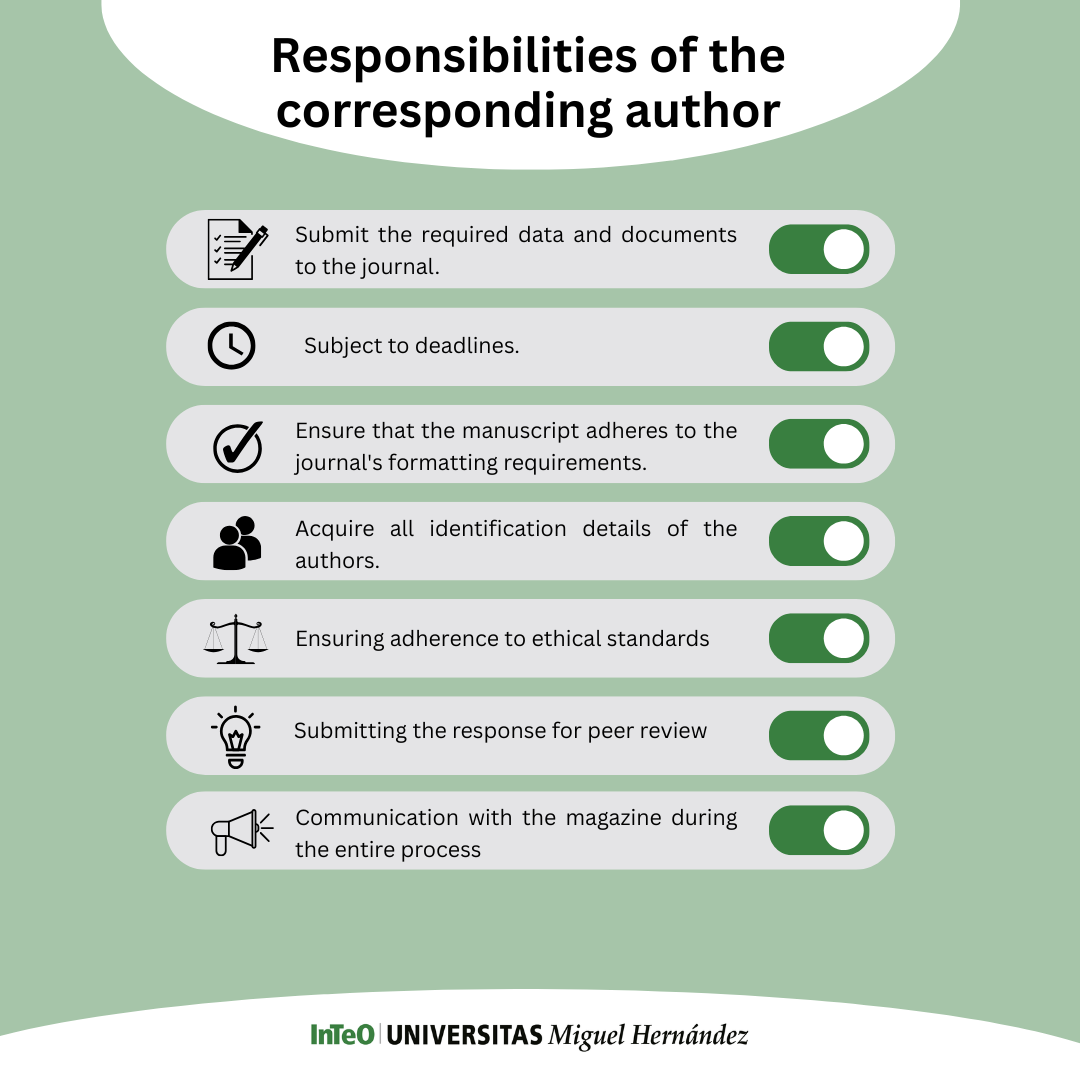
Submitting a manuscript to a journal is a process carried out by the corresponding author of the article. This author takes the lead in the submission process and assumes primary responsibility for all communication with the journal during submission, peer review, and publication. The tasks assigned to the corresponding author include:
- Providing the journal with the required data and documents.
- Keeping track of deadlines.
- Ensuring the manuscript contains all sections required by the journal and complies with its guidelines.
- Gathering all authors’ details (affiliations, email addresses, ORCID identifiers, etc.).
- Ensuring compliance with ethical standards.
- If the manuscript has been submitted to a peer-reviewed journal, once the editor provides the reviewers’ comments, the corresponding author — with the support of the other authors — is responsible for submitting the response to the reviewers’ comments, contributions, and suggestions.
Infografía inspirada en la proporcionada por la editorial Elsevier. Disponible en: https://scientific-publishing.webshop.elsevier.com/publication-recognition/what-corresponding-author/?utm_source=pinterest.
3) Submitting the manuscript to the journal platform
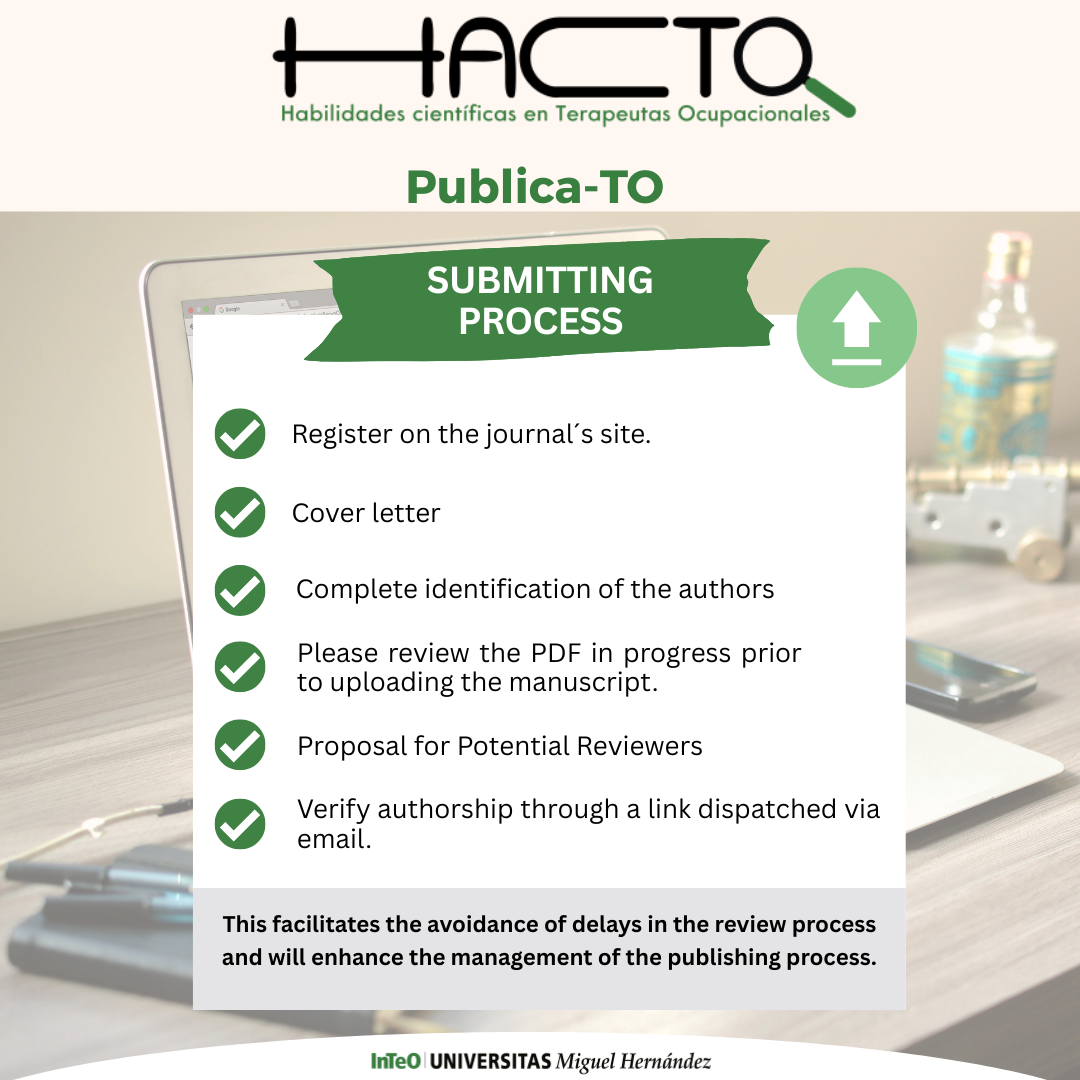
The manuscript submission process is generally carried out through the chosen journal’s website or via an external manuscript management platform linked from its site. For example, AJOT uses the Manuscript Central platform. If submitting to a journal for the first time, it will be necessary to register on the platform by selecting “Create an Account.” If an account already exists, simply log in with your credentials to proceed with the submission.
At this stage, the corresponding author must review the manuscript style and requirements detailed in the “author guidelines ” once more, and check whether any additional documentation needs to be included (ethics committee approval documents, datasets, etc.). For example, the American Journal of Occupational Therapy requires the submission of the “Copyright Transfer/Author Certification/Financial Disclosure Form” and the “Pre Submission Checklist for Authors “. alongside the manuscript. It is also essential to include information on funding, potential conflicts of interest, and author contributions, among other important aspects.
In addition to the documents accompanying the manuscript, it is common to include a brief cover letter. This letter should clearly identify the manuscript and highlight its importance or relevance to the journal’s subject area. It should provide a concise summary of the manuscript’s content, emphasising the main findings, innovations, or contributions to the field. It is useful to explain why the manuscript is suitable for the specific journal and how it aligns with its scope and aims. A brief statement on the originality of the work and its added value may also be included, along with any relevant information that may capture the editor’s or reviewers’ attention. It is advisable to mention whether the manuscript has been presented at previous conferences, whether it has received any financial support, or whether there are any conflicts of interest to be declared. A well-crafted cover letter not only facilitates the editor’s understanding of the manuscript, but also contributes to a more efficient and effective evaluation of the submitted work.
In some cases, a blinded manuscript may be required — that is, all information that could identify the authors, such as the name of the study or ethics committee, must be removed. In most cases, the title page containing the authors’ names and affiliations must also be submitted separately. It is important that the authors’ names are consistent across all documents and are always accompanied by their affiliations, ORCIDidentifiers, or email addresses..
Some journals offer authors the option of suggesting reviewers for their article. This can be particularly valuable, as it allows experts in the field with in-depth knowledge of the topic to be proposed. When this option is available, authors should select reviewers who not only have experience and credibility in the manuscript’s subject area, but who are also impartial and free from conflicts of interest with the work. The suggestion should be accompanied by a brief justification of why each proposed reviewer is suitable, including their relevant experience, recent publications, and area of specialisation. It should be noted that, although authors may suggest reviewers, the final decision rests with the journal editor, who may accept or decline suggestions based on availability, impartiality, and fit with the manuscript’s topics. Journals typically have policies in place to ensure transparency and fairness in the review process, so author recommendations are considered as additional guidance rather than binding requests.
Once all required information and documents have been uploaded to the journal platform, a final check should be carried out to ensure that everything is correct and complete. To facilitate this, the platform typically generates a proof PDF of the manuscript, which will be sent by email. If any errors or inconsistencies are found, return to the platform to make the necessary corrections before finalising the submission. This review should be completed carefully, as once the proof PDF is confirmed, the manuscript will proceed to the next stage. Once this process is complete, the corresponding author — or in some cases all authors — will receive an email confirming submission to the journal. In some cases, it will also be necessary to confirm your identity as an author via a link provided in the email. This link will direct you to a platform where your role as author can be validated, and registration may be required if you do not already have an account. Completing this confirmation process correctly is essential to ensure the manuscript is managed efficiently and that all parties are properly registered in the journal’s system. This helps to avoid delays in the review process and contributes to more effective management of the publication workflow. Authors can also track the status of their manuscript through their account on the journal platform.
Finally, it is very important not to submit the same manuscript simultaneously to two different journals, as this constitutes a breach of publication ethics. Authors should wait for acceptance or rejection before preparing the manuscript for submission elsewhere.
Recommended references
- Moore S. Submitting a Manuscript to a Scientific Journal. Respir Care. 2023;68(9):1314-1319. doi: 10.4187/respcare.11054.
- Balch CM, McMasters KM, Klimberg VS, Pawlik TM, Posner MC, Roh M, et al. Steps to Getting Your Manuscript Published in a High-Quality Medical Journal. Ann Surg Oncol. 2018;25(4):850-855. doi: 10.1245/s10434-017-6320-6. (1)
- Author Servies; 2024. What is a Corresponding Author? Available from: https://scientific-publishing.webshop.elsevier.com/publication-recognition/what-corresponding-author/
- Laboreal [Internet]. Universidade do Porto; 2022. ¿Cómo enviar un artículo? Available from: https://journals.openedition.org/laboreal/810

Rocío Muñoz Sánchez
Occupational Therapist, Master’s Degree in Occupational Therapy in Neurology, and Master’s Degree in Public Health. Pre-doctoral Researcher in the PhD Program in Public Health, Medical and Surgical Sciences. Collaborator at InTeO.

Irene Campos Sánchez
Occupational Therapist, Master's in Neurological Occupational Therapy and Master's in Public Health. FPU Pre-doctoral Researcher in the PhD Program in Public Health and Medical and Surgical Sciences. Collaborator at InTeO.
Translate by: Beatriz Espinosa
Occupational Therapist, holding a Master's Degree in Intervention for Functional Diversity in Childhood and specialized training in child development and mental health. University degree officially recognized in Australia.
Campos Sánchez, I., & Muñoz Sánchez, R. (2024, septiembre 25). Manuscript submission process to scientific journals PublicaTO – Scientific Skills in Occupational Therapy by InTeO. https://hacto.umh.es/en/2024/09/25/manuscript-submission-process-to-scientific-journals/
This work is licensed under a Creative Commons Licence.
