A scientific article is a scholarly work that describes and analyses the original or reviewed findings of a research study, with the aim of contributing to the advancement of knowledge in a specific field. Such articles are generally published in high-impact journals subject to a peer review process. However, even after this oversight, works containing significant errors are sometimes published. But what happens when a publication turns out to be flawed?
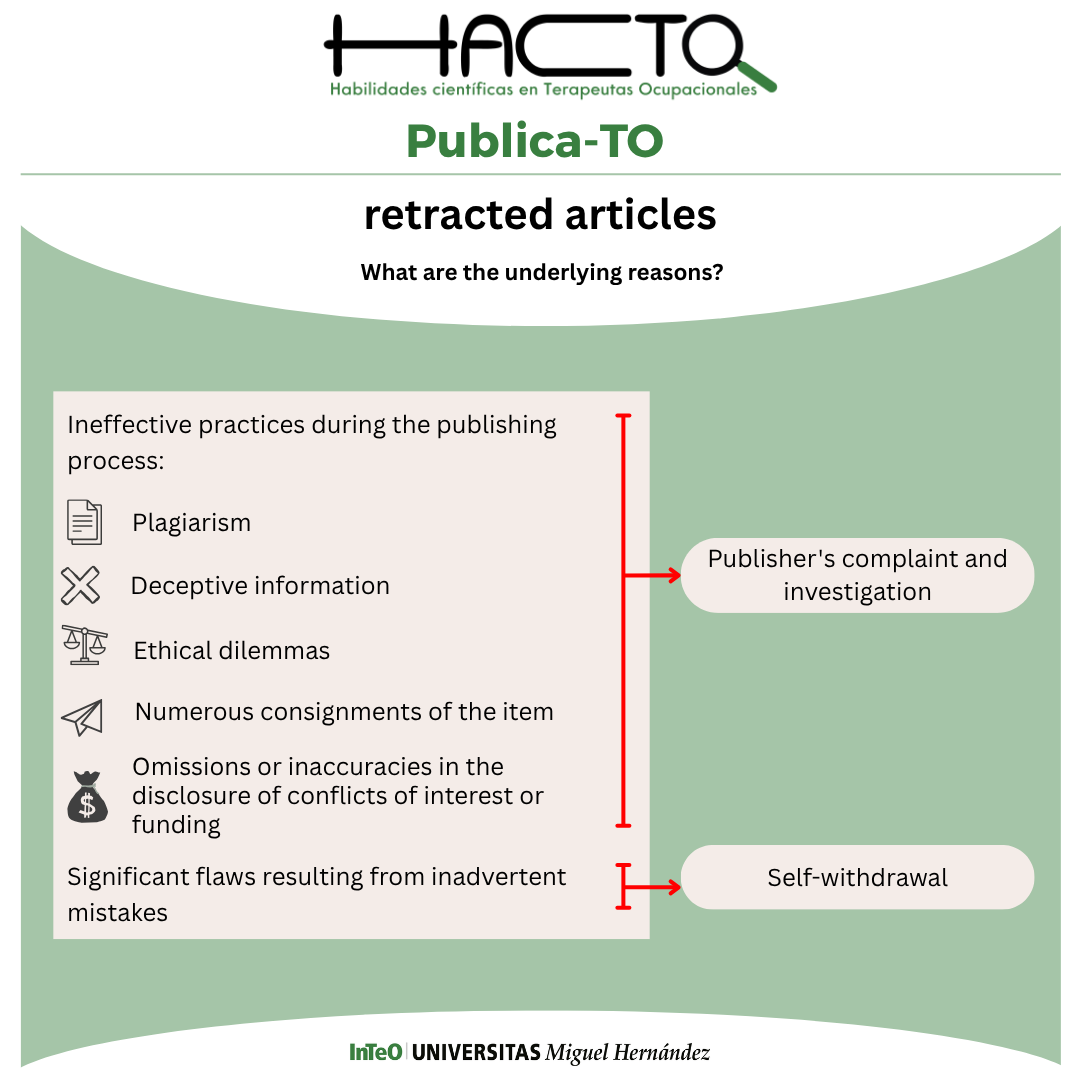
In such cases, the article may be retracted — a process that involves a public notice from the journal indicating that the content of the article is unreliable. The most common forms of misconduct leading to retraction include plagiarism, fraudulent data manipulation, ethical violations, simultaneous submission of the same work to multiple journals, and absent or false declarations of conflicts of interest and funding sources. By contrast, serious unintentional flaws — such as methodological or review errors — are generally the result of honest mistakes. It is worth noting that retraction does not mean removing the article; rather, it is marked as retracted and the reasons are explained, while access to the original text is maintained.
How is an article retracted?
The procedure for retracting an article can be divided into two processes, depending on the nature of the retraction. The simplest case is a self-retraction: the authors themselves detect the error and notify the journal. If the error is correctable, it is typically addressed through an erratum or a corrigendum to the original article. If, however, the issue is serious enough to compromise the validity of the results or involves misconduct, a retraction notice is issued explaining the reason for the error transparently and clearly stating that the content is unreliable — though the article is neither withdrawn from the journal nor deleted.
When there are suspicions of misconduct, whether in the research itself or in the drafting of the manuscript, any reader may submit a formal complaint setting out their reasons. If, following investigation, a retraction is deemed necessary, a complaint-based retraction process will be initiated. In this case, the journal opens a file, gathers the relevant evidence, and asks the authors to submit their response. Once all information has been collected, the journal’s editorial team examines the case thoroughly and decides whether to proceed with retraction. Although self-retractions are generally viewed more favourably, they sometimes conceal what are effectively complaint-driven retractions, allowing authors to avoid the reputational damage associated with publishing fraudulent content. It should be noted that each publisher has its own retraction policies, and it is advisable to consult these.
What is the difference between a retracted article and a corrected one?
A corrected article addresses minor errors or adds clarifications that do not invalidate the main results, whereas a retraction indicates that the article contains errors that compromise the validity of its findings.
How do I identify a retracted article?
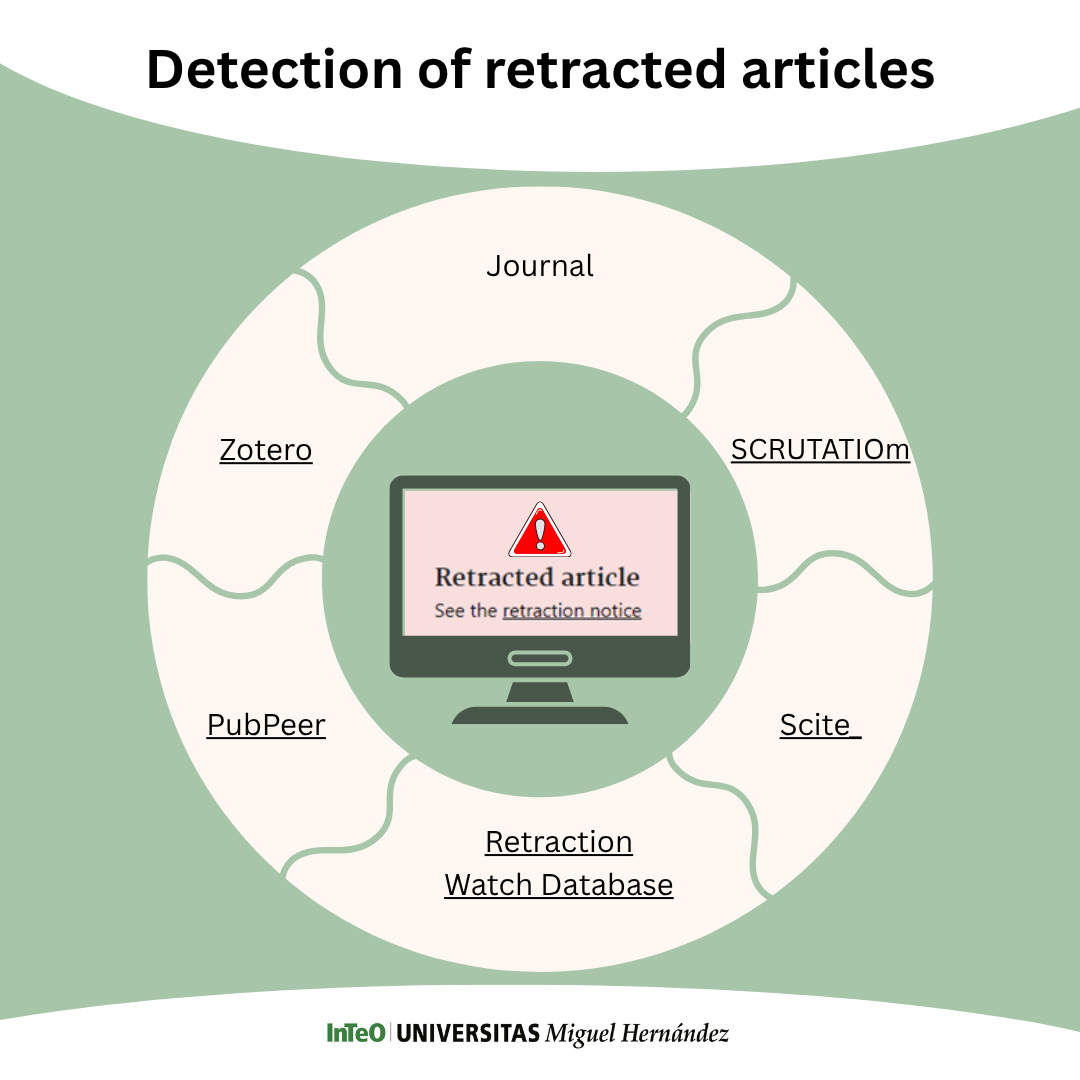
The resources presented below can help identify errors and misconduct, and encourage a critical reading of the articles we consult or cite. The simplest way to check whether an article has been retracted is to verify it on the journal or publisher’s website, where it will be flagged with a visible notice, as shown in the image:

The bibliographic reference manager Zotero also displays a similar notice indicating that the article has been retracted:

In other cases, identification is not so straightforward, and we may need to turn to resources that can help us find retracted articles, corrections, or comments about a given publication. Below are some useful tools:
- Retraction Watch Database (RWDB): a public database that compiles information on retracted scientific articles.
- SCRUTATIOm method: a system for detecting retracted literature cited in systematic reviews and meta-analyses, using a combined approach with the Scopus database and the Zotero reference manager.
- Scite_: a platform that uses artificial intelligence to analyse how scientific articles are cited, showing citations that support or contradict them. It is backed by the National Science Foundation (NSF), the National Institute on Drug Abuse (NIDA), and the National Institutes of Health (NIH).
- PubPeer: a platform where already-published scientific articles can be publicly and anonymously commented on and discussed, with the option for authors to respond.
Can I cite a retracted article if it contains information I need?
Yes, you can cite a retracted article, although it is not recommended, as doing so may compromise the validity of your own work. If you choose to do so — for example, in the discussion section, to challenge prior knowledge based on erroneous data or conclusions — you must indicate this explicitly in your manuscript.
Why would someone want to publish incorrect information?
Taking a broader view, this is a question worth considering. In many cases there is no deliberate intent; rather, current trends in research favour articles published quickly and imprecisely, leading to low-quality studies or, in some cases, to unethical conduct in science. The fact that the number of publications determines the prestige and career progression of researchers, combined with the growing number of predatory journals that lack adequate editorial controls, can lead to the publication of inaccurate information. In health professions such as ours, we must take particular care with the work we publish, as it could encourage harmful trends that lead to poor clinical practice.
References:
- Elsevier Language Services. Paper Retraction: Meaning and main reasons [Internet]. Elsevier Author Services – Articles. Elsevier Author Services – Blog; 2021 [consultado 22 May 2025]. Disponible en: https://scientific-publishing.webshop.elsevier.com/research-process/paper-retraction-meaning-and-main-reasons/
- Retratacción de artículos [Internet]. Fecyt.es. [consultado 22 May 2025]. Disponible en: https://recyt.fecyt.es/index.php/retos/Retractacion
- Enago Academy. When Should a Paper Be Retracted? [Internet]. Enago; 2024 Dec [consultado 22 May 2025]. Disponible en: https://www.enago.com/academy/when-should-a-paper-be-retracted/
- Campos-Varela I, Villaverde-Castañeda R, Ruano-Raviña A. Retraction of publications: a study of biomedical journals retracting publications based on impact factor and journal category. Gac Sanit [Internet]. 2020;34(5):430–4.
- Candal-Pedreira C, Guerra-Tort C, Ruano-Ravina A, Freijedo-Farinas F, Rey-Brandariz J, Ross JS, Pérez-Ríos M. Retracted papers originating from paper mills: a cross-sectional analysis of references and citations. J Clin Epidemiol. 2024;172:111397.
- Raviña AR, Pedreira CC, López FG. El fraude en ciencia perjudica seriamente a la salud (y a la propia ciencia). The Conversation [Internet]. 2023 [consultado 22 May 2025]; Disponible en: http://theconversation.com/el-fraude-en-ciencia-perjudica-seriamente-a-la-salud-y-a-la-propia-ciencia-198079
Resources for detecting retracted articles:
- Retraction Watch. Retraction Watch [Internet]. New York: Center for Scientific Integrity; 2010 [consultado 23 May 2025]. Disponible en: https://retractionwatch.com/
- Morán JM, Santillán-García A, Herrera-Peco I. SCRUTATIOm: cómo detectar literatura retractada incluida en revisiones sistemáticas y metaanálisis usando SCOPUS© y ZOTERO© [SCRUTATIOm: how to detect retracted literature included in systematics reviews and metaanalysis using SCOPUS© and ZOTERO©]. Gac Sanit. 2022;36(1):64-66.
- ai. Scite: A smart citation index [Internet]. New York: Scite Inc.; 2018 [consultado 23 May 2025]. Disponible en: https://scite.ai/
- PubPeer: The online journal club [Internet]. [s.l.]: PubPeer Foundation; [fecha desconocida] [consultado 23 May 2025]. Disponible en: https://pubpeer.com/
- Corporation for Digital Scholarship. Zotero [Internet]. Fairfax (VA): George Mason University; 2006 [consultado 23 May 2025]. Disponible en: https://www.zotero.org/

Empar Casaña Escriche
Occupational Therapist, Master’s in Occupational Therapy in Neurology. FPU Pre-doctoral Researcher in the PhD Program in Public Health, Medical and Surgical Sciences. Contracted Researcher at InTeO.

Mónica Siendones Molina
Graduate in Health Engineering from the University of Málaga and holder of a Master’s degree in Biotechnology and Bioengineering from Miguel Hernández University. She is an InTeO scholarship recipient, supported by a grant for internships focused on promoting research activities within university departments and institutes.

Traducido por: Beatriz Espinosa
Terapeuta Ocupacional, con Máster en Intervención en la Diversidad Funcional en la Infancia y formación especializada en desarrollo infantil y salud mental. Título universitario homologado en Australia.
Casaña Escriche, E., & Siendones Molina, M. (2025, 8 de septiembre). Retracted articles. PublicaTO – Habilidades Científicas en Terapia Ocupacional de InTeO. https://hacto.umh.es/en/2026/07/28/retracted-articles/