
When reading a scientific article, it is common to come across a cross-sectional study. But do we really know what it is? What kind of research questions does it address? In this entry, we will cover the fundamental aspects of this type of study.
What is a cross-sectional study?
Cross-sectional studies are observational in design. As the name suggests, observational studies are those in which the researcher observes participants without intervening in what they do (further information on observational studies can be found here). One of the defining characteristics of this type of study is that data are collected at a single point in time — in other words, it is like taking a snapshot of what is happening at a specific moment.
Cross-sectional studies are generally used to explore the health and disease status of a specific population at a given place and time. Although they typically focus on individuals, they can also be applied to the study of institutions, communities, devices, or events, depending on the research objective. In the field of occupational therapy, this type of study allows for the analysis of aspects such as participation in meaningful occupations, occupational performance, or the presence of occupational dysfunction in specific populations. They can also be used to explore contextual barriers or identify needs within community or institutional settings.
Depending on their objective, cross-sectional studies can be classified into two types:
Descriptive cross-sectional studies aim to determine the presence or absence of a disease or health condition in a specific study population (which is why they are also known as prevalence studies or population surveys). In occupational therapy, they are used to estimate the frequency of certain occupational performance patterns, levels of participation, or the presence of occupational dysfunction in specific populations, such as individuals with neurological damage, developmental disorders, or those at risk of social exclusion. An example research question for a descriptive cross-sectional study might be: What is the prevalence of sensory reactivity in children aged 3 to 7 years?
Analytical cross-sectional studies are generally designed to explore associations between an event of interest (such as a disease, health problem, or outcome of interest) and possible related factors. In occupational therapy, they allow examination of the relationship between occupational well-being and variables such as physical and mental health, environment, functional skills, or social support — contributing to the identification of factors that influence occupational participation and informing future interventions. An example research question for an analytical cross-sectional study might be: Is there an association between sensory reactivity in children aged 3 to 7 years and increased parental stress?
It is important to note, however, that this type of study assesses both exposure and outcome simultaneously, making it impossible to determine which came first. Cross-sectional studies therefore cannot establish cause-and-effect relationships, but only cross-sectional associations (without determining directionality). That said, this does not mean they lack value. They are highly useful for generating hypotheses. In occupational therapy, for example, this means we cannot claim that low occupational well-being causes deterioration in mental or functional health (or vice versa), but we can identify relevant patterns that help us better understand these relationships. Precisely because of their capacity to generate hypotheses and highlight emerging occupational needs, cross-sectional studies are very useful for guiding the planning of interventions and new lines of research.
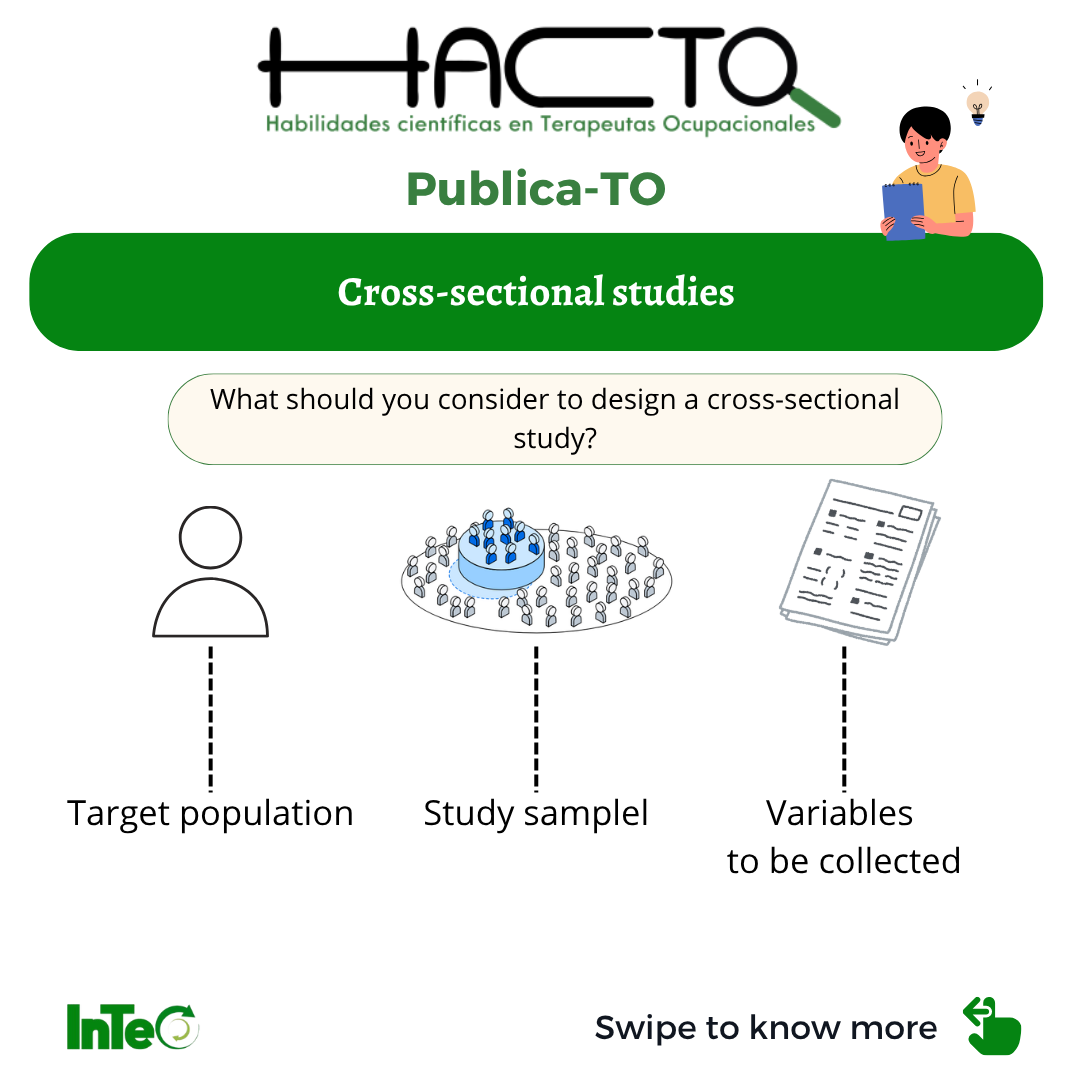
If I want to design a cross-sectional study, what should I consider?
Designing a cross-sectional study that ensures adequate precision and validity of results requires attention to three essential aspects: the target population, the study sample, and the variables.
– Target population: correctly identifying who we want to study and how we will select the individuals who will take part in the research. For example, if we want to know whether developmental coordination disorder affects participation in children aged 6 to 10 years, the target population would be all children of that age within the defined study setting.
– Study sample: the estimated number of individuals from whom data must be collected in order for the study results to be reliable and generalisable to a sector of the population. It is necessary to calculate the required sample size.
– Variables to be collected: these should be defined based on what the scientific literature indicates about the factors that may influence the variable of interest, as well as sociodemographic or lifestyle variables that could act as confounding factors. It is equally important to establish clear inclusion and exclusion criteria, and to define which variables will be collected, how they will be collected, and with which measurement instruments. For example, if we wish to study the relationship between participation in meaningful activities and the mental health of parents of children attending early intervention services, we could collect information on engagement in meaningful activities using self-administered questionnaires — for instance, the Engagement in Meaningful Activities Survey (EMAS).
What real examples can I find in Occupational Therapy?
The InTeO Group (https://inteo.umh.es) has conducted several cross-sectional studies in Occupational Therapy. Two examples are detailed below:
InProS Study
In 2016, the cross-sectional study Infancia y Procesamiento Sensorial (InProS, https://inteo.umh.es/inpros/) was carried out with children aged 3 to 7 years in the province of Alicante, with the aim of estimating the prevalence of sensory reactivity and exploring associated factors. The study was conducted across 21 schools in the province of Alicante using a parent-completed questionnaire that gathered information on children’s sensory processing using the Short Sensory Profile (SSP), alongside sociodemographic and lifestyle variables for both parents and children. The full protocol can be read here:https://www.mdpi.com/1660-4601/17/4/1447.
HaCTO Screen Study
Between April and June 2020, a Google Forms survey was distributed to Spanish-speaking occupational therapists via social media with the following aims: (1) to describe the level of acquisition of scientific skills and academic performance in Spanish-speaking occupational therapists; and (2) to examine the factors associated with these skills. A total of 1,159 occupational therapists participated in this project (https://hacto.umh.es/hacto-screen-2/). Information was collected on sociodemographic characteristics, academic and professional background, assessment of scientific skills, training and research development needs, and experience as a researcher and/or academic. The project protocol can be read here: https://www.mdpi.com/2227-9032/9/2/124.
Additional cross-sectional studies have been conducted in occupational therapy, including:
Empathy in occupational therapy students: a cross-sectional study at a Spanish university (https://bmjopen.bmj.com/content/12/4/e058821.long).
This study explored levels of empathy among occupational therapy students at a Spanish university. A total of 221 students participated, and two instruments were used to assess empathy: the Davis Interpersonal Reactivity Index (IRI) and the Jefferson Scale of Empathy (JSPE-HPS-S). High levels of empathy were found across all dimensions assessed, and statistically significant differences were identified by gender, with higher scores in women on both the IRI and the JSPE-HPS-S.
Occupational performance problems in people with depression and anxiety (https://doi.org/10.1080/11038128.2021.1882562).
This cross-sectional study analysed problems in the performance of daily occupations in individuals aged 18 to 65 years with depression or anxiety. A total of 118 participants took part, and the Canadian Occupational Performance Measure (COPM) was used. Participants reported difficulties primarily in home management, socialisation, and self-care, as well as low levels of performance and satisfaction with these occupations.
Advantages and limitations of cross-sectional studies
One of the main strengths of cross-sectional studies is their feasibility. They require less time and fewer financial resources than other study designs. They also allow for the simultaneous study of multiple exposures and outcomes, and there are no losses to follow-up, since all data are collected at a single time point. Finally, they are useful for generating hypotheses.
However, cross-sectional studies also have limitations. The most significant is the inability to establish causality: since there is no follow-up over time, it is not possible to determine whether the exposure preceded the observed outcome. They are also not well suited for studying rare diseases, as a very large sample would be required to obtain sufficient cases.In addition, they may be subject to biases such as selection bias or information bias (further information on types of error in research studies can be found here).
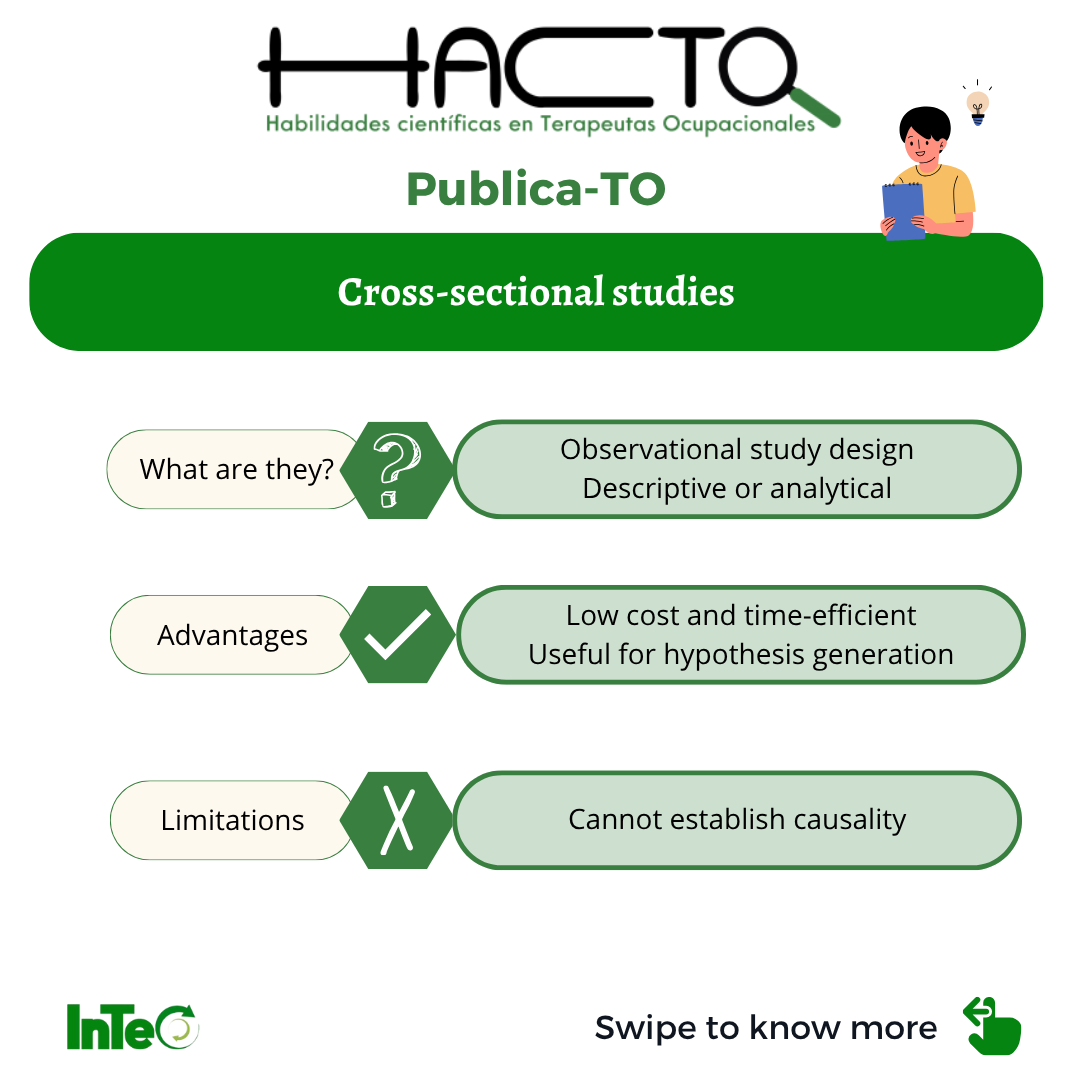
Although cross-sectional studies do not allow for the establishment of causality, their low cost and capacity to generate hypotheses make them a valuable tool — and they can mark the first step towards larger-scale, higher-impact projects.
Want to learn more?
Levin KA. Study design III: Cross-sectional studies. Evid Based Dent. 2006;7(1):24-5. DOI: 10.1038/sj.ebd.6400375.
Rothman KJ, Greenland S, Lash TL. Modern Epidemiology. 3rd ed. Philadelphia, PA: Wolters Kluwer Health/Lippincott Williams & Wilkins; 2012.
Manual de Epidemiología y Salud Pública para Grados en Ciencias de la Salud. Editorial Médica Panamericana. ISBN: 9788491101734

Rocío Muñoz Sánchez
Occupational Therapist, Master’s Degree in Occupational Therapy in Neurology, and Master’s Degree in Public Health. Predoctoral Researcher in the PhD Program in Public Health, Medical, and Surgical Sciences. Collaborator at InTeO.
Mª Paula Noce
Occupational Therapist, Master's in Neurological Occupational Therapy and Master's in Public Health.Pre-doctoral Researcher in the PhD Program in Public Health and Medical and Surgical Sciences. Collaborator at InTeO.
Translate by: Beatriz Espinosa
Occupational Therapist, holding a Master's Degree in Intervention for Functional Diversity in Childhood and specialized training in child development and mental health. University degree officially recognized in Australia.
Noce, P., & Muñoz, R., (2026, 2 de feberero). Cross-sectional studies: what are they and what are they used for?. PublicaTO – Habilidades Científicas en Terapia Ocupacional de InTeO. https://hacto.umh.es/en/2026/07/28/cross-sectional-studies-what-are-they-and-what-are-they-used-for/
