
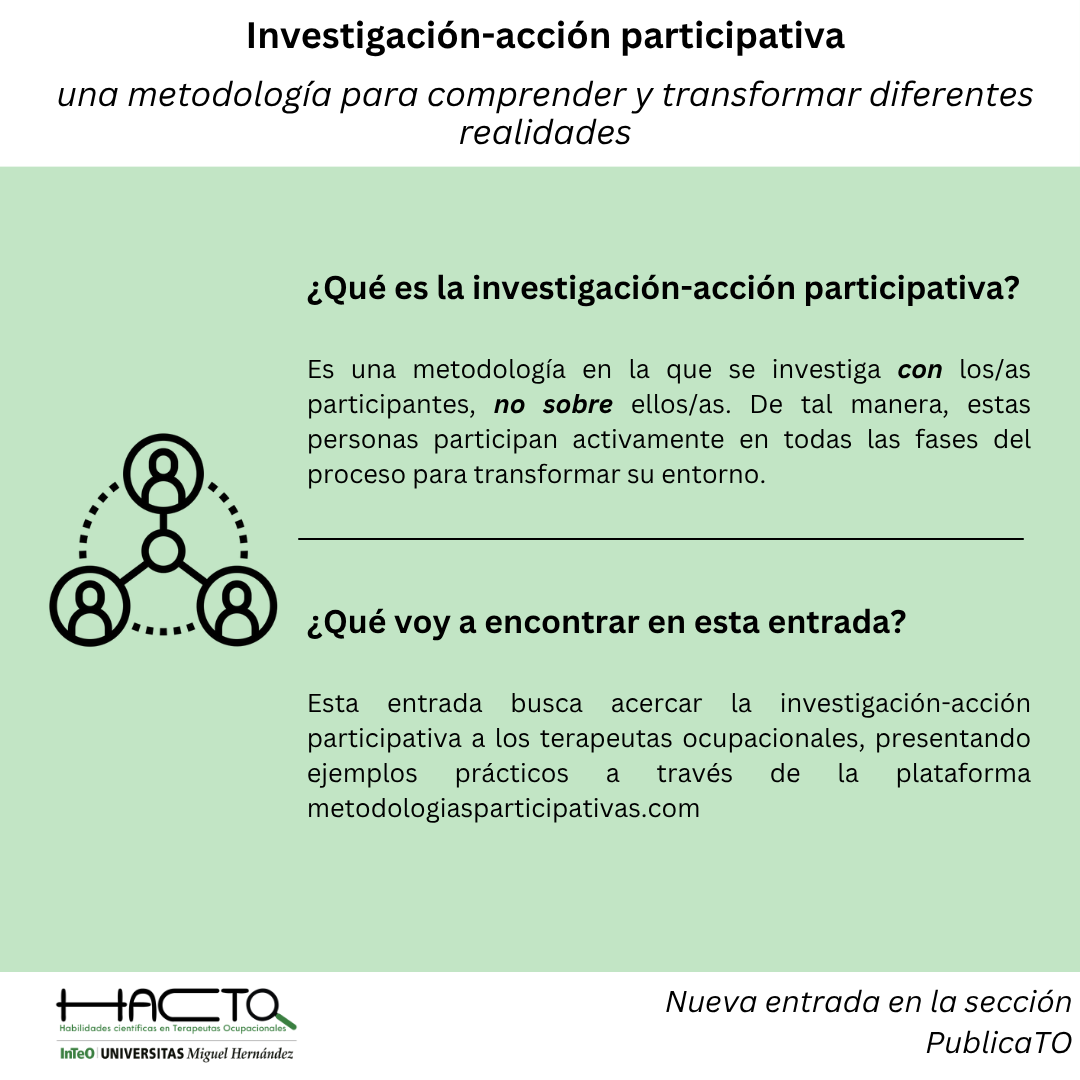
Participatory Action Research (PAR) is a methodology focused on investigating a situation through the active involvement of the people who live within a given reality. Rather than conducting research about them, knowledge is created with them, recognising and drawing on their lived experience as a source of information. This approach is grounded in the principle that those who face situations of injustice or social inequality are best placed to provide insight into them. Participants take on a leading role in every phase of the process: from defining the problem to implementing the actions needed to address it (1,2).
This entry therefore aims to introduce occupational therapists to PAR at both a theoretical and practical level. We also invite you to explore the website metodologiasparticipativas.com, a resource designed for those wishing to deepen their understanding of this methodology and you will be able to take part in our own participatory dynamic!
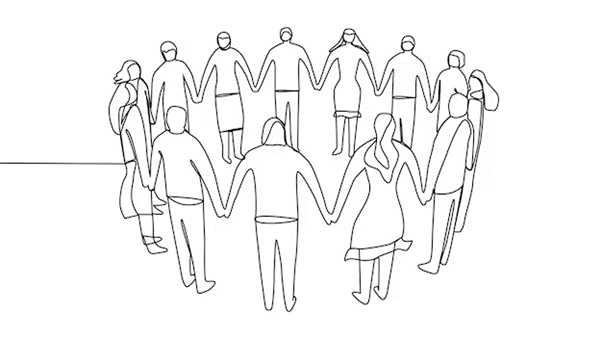
Participatory Action Research in Occupational Therapy
In occupational therapy, PAR proves valuable by combining active participation, self-determination, and empowerment to build collective knowledge and transform realities. This methodology draws on lived experience and community bonds, and provides a framework that alternates and integrates reflection and action in order to develop an in-depth understanding of complex issues. Participatory dynamics take this a step further: they promote co-creation, facilitate dialogue, and enable the design of contextualised solutions. In this way, PAR enriches professional practice, strengthens a sense of belonging, and offers a tangible guide for social change.
These processes can be integrated across a range of settings to:
- Develop in-depth assessments of local realities.
- Recover knowledge that is frequently rendered invisible.
- Collectively identify problems and opportunities.
- Collaboratively design contextualised solutions.
- Strengthen community bonds and a sense of belonging.

An interesting example within our profession is the study “Game Changers: A participatory action research project for/with students with disabilities in school sport settings” (3), which illustrates how PAR can be applied in educational settings to promote the inclusion of people with disabilities. In this case, students with disabilities participated actively alongside teachers and researchers, working collaboratively to create adapted sporting spaces and empower students with disabilities. The study highlights the importance of active student participation: the students themselves made decisions that had a direct impact on their well-being within the school context — an environment was created in which they could make choices, express their needs, and transform their own reality in their schools.
A further example is the study “Developing a fall prevention program in an inpatient spinal cord injury rehabilitation unit: A participatory action research study” (4), which applies PAR within a rehabilitation unit for people with spinal cord injury. Through the active participation of both service users and professionals, a falls prevention programme was developed. This study underscores the role of PAR in generating practical solutions to a specific problem.
Finally, an example drawn from the EQo-Mental Project of the InTeO (https://inteo.umh.es/eqomental/) demonstrates how PAR can be applied with parents of children attending an early intervention centre (EIC), with the aim of identifying which meaningful activities they have stopped engaging in and what they can do to resume them. In practice, groups were organised at each EIC, creating spaces where parents could share experiences, reflect on their reality, and actively participate in transforming it. These sessions sought to identify needs, propose actions, and build connections with other families in similar situations. Further information is available here: https://youtu.be/53rvGDsieOM?si=OG6cSsk1CwzI-Iry
Taken together, these three examples show how PAR can be adapted to different contexts, yielding valuable insights. However, like any methodology, its application also presents challenges. It is important to note that PAR requires time and flexibility on the part of researchers, which can make implementation difficult in resource-limited settings. It should also be kept in mind that, although PAR is a flexible methodology, rigour is essential: participatory dynamics must be carefully planned and data collected precisely. Nevertheless, when applied correctly, PAR offers a unique opportunity to build knowledge alongside participants.
I am an occupational therapist working in a clinical setting. How can I use PAR?
PAR can be a valuable methodology for clinical practice. As a collaborative approach, it enables the design of interventions that are more closely aligned with the real needs of the people we work with. As a result, PAR allows us to step back from the expert role and shift an active part in the process to service users, enabling them to participate in decision-making.
For example, if working as an occupational therapist in a mental health unit, PAR could be used to identify together with service users that one of their main concerns is the lack of meaningful activities during the afternoons, which causes them distress. From there, PAR-based sessions could be designed to address this problem alongside them, generating ideas such as cooking workshops or reading groups, and then working together to put them into practice. This example is supported by evidence for the use of PAR in occupational therapy with people experiencing mental health difficulties (5).
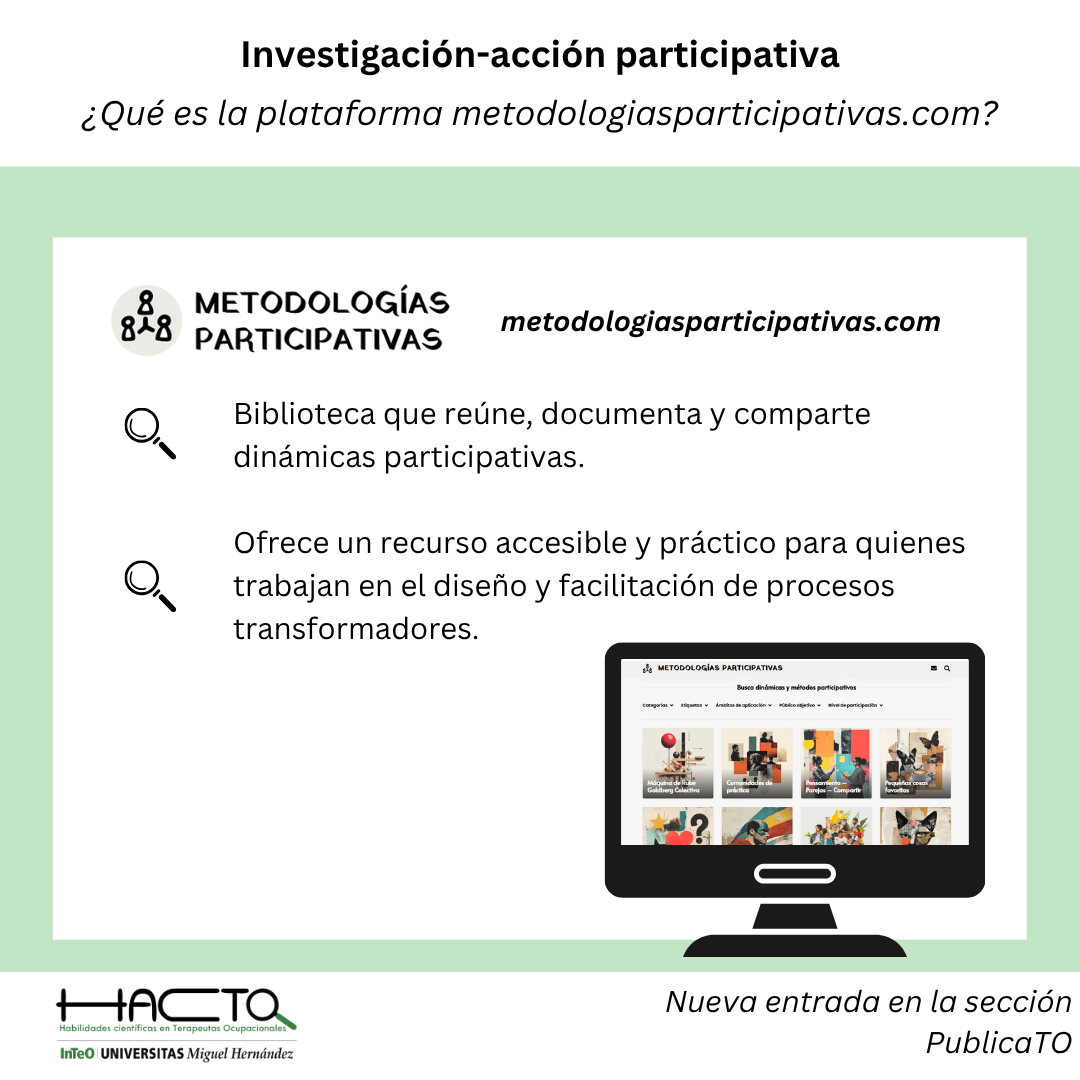
Metodologías Participativas website
Library of participatory dynamics: a key resource for PAR
‘Metodologías Participativas’ is a library that brings together, documents, and shares participatory dynamics to inspire, facilitate, and strengthen collective processes of learning, action, and research. Its purpose is to offer an accessible and practical resource for those working in the design and facilitation of transformative processes.
Through these dynamics — ranging from well-known and classic approaches to more original and innovative concepts — the web library aims to support professionals, educators, researchers, activists, and community organisations in creating meaningful participatory experiences.
Each dynamic includes descriptions, step-by-step guidance, adaptation tips, materials, platforms, and recommendations on how to implement the dynamics both in-person and online, along with practical inspiration such as examples and useful resources.
Some examples of PAR dynamics
A visual technique for collectively exploring what different community actors see, feel, hear, and think.
A collective walk through a given territory in which participants observe and discuss significant elements of their environment.
A collaborative visual construction of local history that identifies milestones, moments of change, and determining factors.
Groups of six people discuss a topic for six minutes and then share their conclusions with the wider group.
A visual representation in which the roots represent concrete actions, the trunk the strategies, and the branches the expected outcomes.
Alongside these dynamics, it is valuable to explore less widely known approaches, adapt them to the needs of the group, or even develop entirely original dynamics designed specifically for each context and purpose.
Conclusion
PAR is a methodology that enables the generation of knowledge from lived experience, involving participants as active agents in the research process. Throughout this entry we have explored how its principles can enrich our profession, along with several examples that illustrate its applicability. From InTeO, we invite you to continue exploring these research methodologies; the platform metodologiasparticipativas.com can be a good starting point for those wishing to discover different participatory dynamics.
And you, how would you bring participatory dynamics into your own professional practice?
We invite you to take part in our own participatory dynamic: a short digital exercise designed to exchange perspectives, inspire one another, and keep learning together from our experiences. It is completely anonymous. Participate here.
References
- Cornish, F., Breton, N., Moreno-Tabarez, U. et al. Participatory action research. Nat Rev Methods Primers 3, 34 (2023). https://doi.org/10.1038/s43586-023-00214-1
- Baum F, MacDougall C, Smith D. Participatory action research. J Epidemiol Community Health. 2006;60(10):854–7. Available from: https://jech.bmj.com/content/60/10/854
- Robinson, Daniel B et al. “Game Changers: A participatory action research project for/with students with disabilities in school sport settings.” Frontiers in sports and active living vol. 5 1150130 (2023). https://doi.org/10.3389/fspor.2023.1150130
- Rahimi S, Khankeh HR, Ebadi A, Mohammadian B, Eghbali M, et al. (2024) Developing a fall prevention program in an inpatient spinal cord injury rehabilitation unit: A participatory action research study. PLOS ONE 19(7): e0304320. https://doi.org/10.1371/journal.pone.0304320
- Javadizadeh E, Oudshoorn A, Letts L, Barbic S, Shanoff C, Marshall CA. Participatory research with persons who experience mental illness in occupational therapy: A scoping review. Can J Occup Ther. 2024;91(2):203–21. Available from: http://dx.doi.org/10.1177/00084174231212760
Mª Paula Noce
Occupational Therapist, Master's in Neurological Occupational Therapy and Master's in Public Health.Pre-doctoral Researcher in the PhD Program in Public Health and Medical and Surgical Sciences. Collaborator at InTeO.

Metodologíasparticipativas.com
Biblioteca online de dinámicas, técnicas, talleres y métodos participativos.
Translate by: Beatriz Espinosa
Occupational Therapist, holding a Master's Degree in Intervention for Functional Diversity in Childhood and specialized training in child development and mental health. University degree officially recognized in Australia.
Noce, P., & MetodologiasParticipativas.com (2025, junio 2). Participatory Action Research: a methodology for understanding and transforming different realities. PublicaTO – Scientific Skills in Occupational Therapy by InTeO. https://hacto.umh.es/en/2025/06/02/participatory-action-research-a-methodology-for-understanding-and-transforming-different-realities/
This work is licensed under a Creative Commons Licence.
