
In this post, we aim to provide a general outline, advice and resources that you can use for this purpose.
Not all abstracts are the same or serve for the same purpose.
In this post we are focusing on two situations: 1) the abstract of a scientific article for a scientific journal and, 2) the abstract of a scientific article for a congress or conference.
What is the abstract of an article?
An abstract is the result of a process of abstraction in which essential points are synthesised and highlighted (Diez, 2007).
As we mentioned previously, the abstract of a scientific article is very important as it is the window to the rest of the article. One of its main objectives is to convince the reader and reviewers that it is worth it to read your study completely.
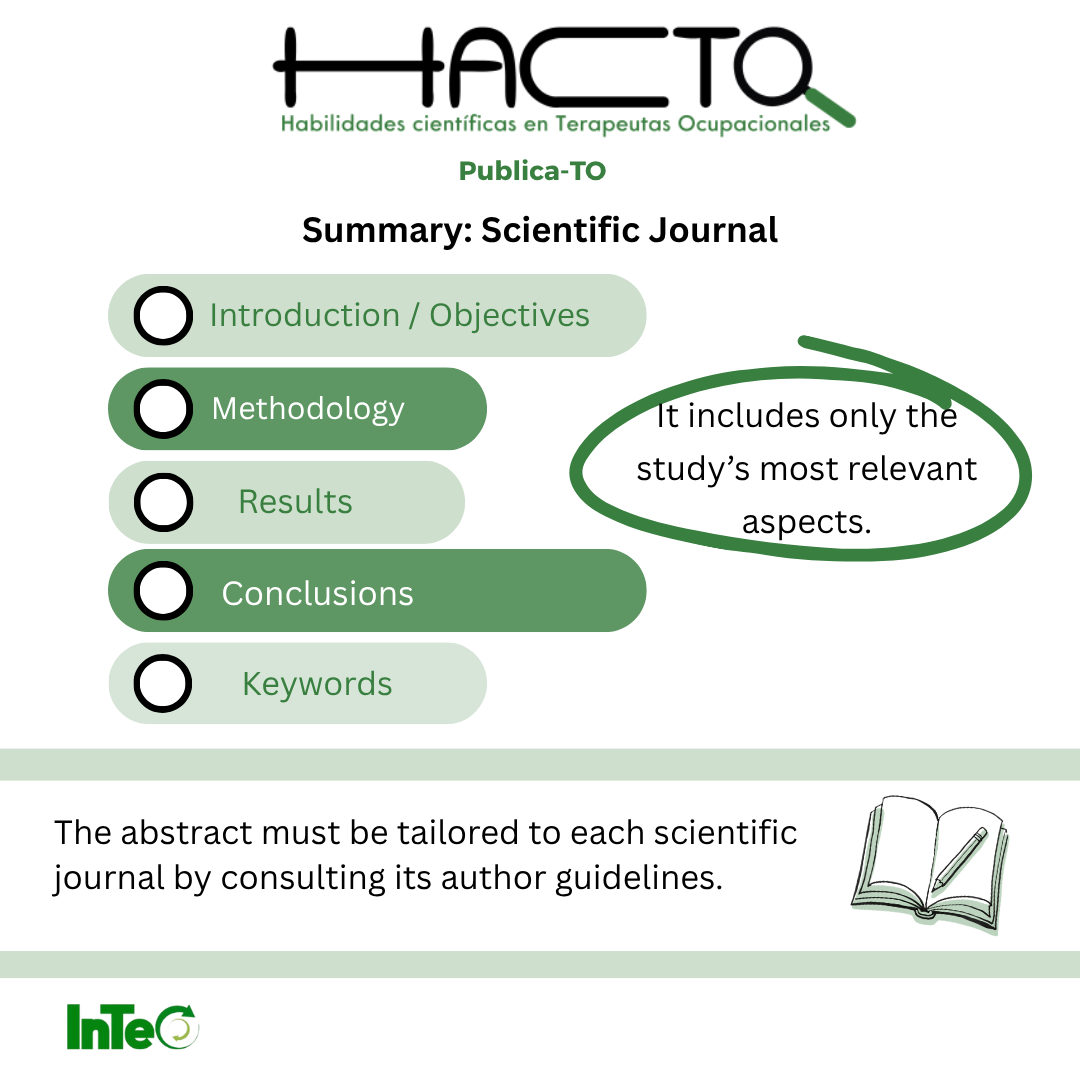
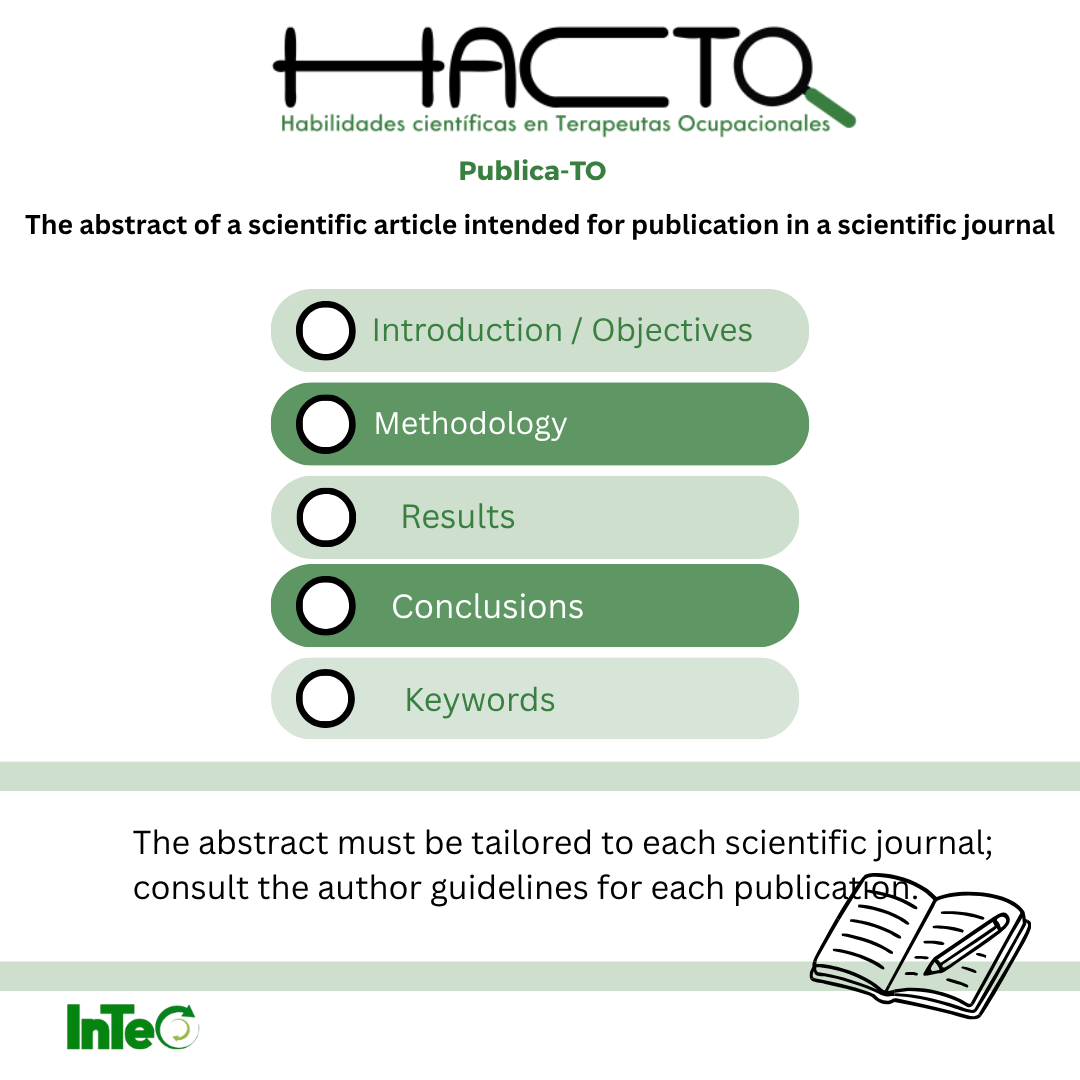
It is important to bear in mind that most scientific journals provide guidelines for authors, so the abstract must be adapted to these guidelines. Each journal has a ‘Guidelines for Authors’ section setting out the guidelines that the abstract must follow. Furthermore, the criteria for each abstract also depend on the type of study being carried out.
Have a look at the  Australian Occupational Therapy Journal ‘s guidelines for authors.
The majority of journals request a structured abstract following the IMRyD structure:
- Introduction / Objectives: Why is the topic relevant and which hypothesis or objective have you established?
- Methodology: How did you do it? In this part, you should include the design of the study, the sample of participants, the variables, the evaluation tools or any technique to collect data. Finally, you should include the type of data analysis (quantitative / qualitative) you have conducted.
- Results: What did you find? In this part, you should report the exact quantitative data that answer the aim of your study of the test conducted (If you are going to report the p-value, check on our post how to do it properly). For qualitative studies, this part usually includes the themes or categories that arise through the analysis.
- Discussion / Conclusions: What does it mean which you have found? What are the contributions of this study to the scientific evidence and how does it impact in the practice?
Click here
2) Abstract of a scientific article for a congress or conference
The abstract for a congress is a bit different as it is sent to a scientific committee. This committee after reading it will decide to accept or not the oral communication or poster. Sometimes, the research is still ongoing by the time the abstract is submitted. Therefore, the abstract has to be more dynamic. The objective is to convince the scientific committee to give you a spot in their program.
This abstract should be adapted to the congress’ guidelines for abstracts, – which are usually defined in the congress’ website. In this case, there is usually a maximum number of words permitted. The abstract should also fit in one of the themes of the congress.
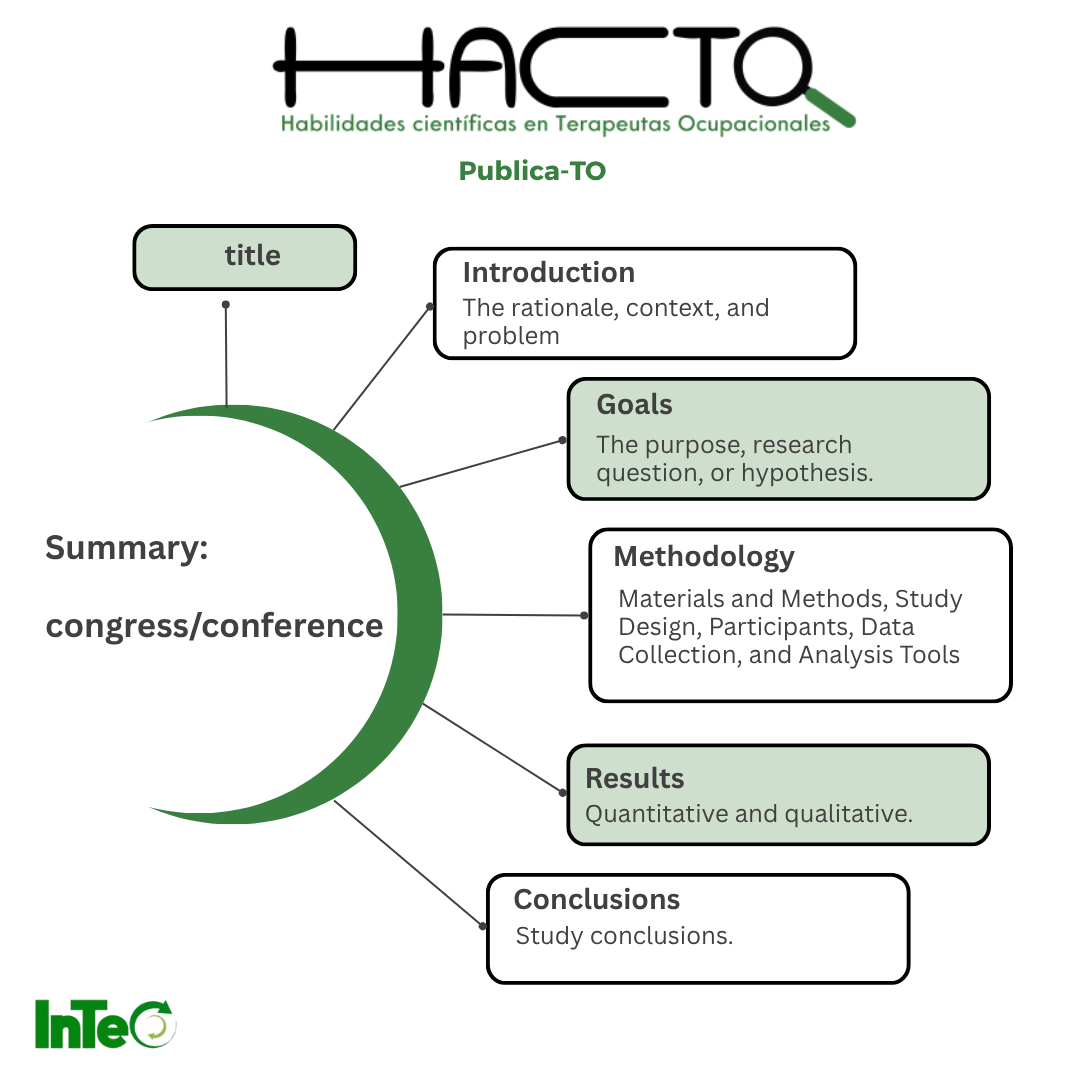
In general lines, the structure of this abstract is:
- Title.
- Introduction (why) and objectives (what purpose).
- Methodology (Materials, methodology, type of study, participants, tools to collect data and type of analysis).
- Results (the most relevant).
- Conclusions.
You can have a look at the previous guidelines published for different conferences as the WOFT 2026 or the Jornadas Internacionales del Grupo InTeO (JoINT) 2025.

- Check the journal or congress guidelines.
- It is recommended to use non-personal and past tenses for the methodology and results. Meanwhile, the conclusions should be written in present tense.
- Use a clear, simple and to the point tone.
- Do not exceed the maximum of words established by the scientific committee or the journal.
- The abstract for a scientific journal should be written at the last , once the manuscript is finished, but do not let it for the last minute.
- The abstract should hold up by itself. This means that while reading it, the reader gets a clear overview of the general study without reading it completely.
- Include the most relevant information in the most transparent way within the allowed guidelines. This will ensure that the study is reproducible through its materials, methods, tools used and controls employed, among others.
- Include only the most relevant references for example “It will be used in the Model of Human Occupation (Kielhofner, 2003).”
- If you can, avoid abbreviations.
- In both cases you will need to include keywords. These are usually between 3 to 10 terms depending on the guidelines you are following. These should be terms that represent the main concepts addressed in your research and make it easier to identify your work in scientific databases. It is advisable to choose specific and relevant terms, avoiding, as far as possible, repeating those that already appear in the title, particularly in scientific articles. Choosing the right keywords will improve the indexing, visibility and retrieval of your work in bibliographic searches.
- In the case of a quantitative study, be concise in the results section, but do not limit yourself to report the p-value alone. Include the main numerical results, such as measures of frequency, central tendency or dispersion, as well as measures of association or effect and their confidence intervals, where appropriate. Remember that the aim is to show not only whether the results are statistically significant, but also their magnitude and clinical or practical relevance.
- If you are reporting a random control trial, you could also check these guidelines for the elaboration of your abstract.
- Send your abstract to your network to get feedback on it.
- Review it as many times as you edit the manuscript. If there is any change in a section, make sure that it is also changed in the abstract.
- If you write the abstract in another language, this should convey the meaning and content of the original.
When writing an abstract for a scientific article, remember that all the information included must be contained within the full text of the article. You must not include any data, results, interpretations or conclusions that have not already been discussed in the manuscript. The abstract must accurately, concisely and coherently reflect the content of the study.
Lastly, we leave here some examples of abstracts and their comments regarding strengths and weaknesses made by the Canadian Association of Occupational Therapy for you to check out.
References
Díez M., B. L. (2007). El resumen de un artículo científico: Qué es y qué no es. Investigación y Educación en Enfermería, 25(1), 14–17. https://doi.org/10.17533/udea.iee.2901
Ferreira, J. C., & Patino, C. M. (2018). Twelve tips to write an abstract for a conference: Advice for young and experienced investigators. Jornal Brasileiro de Pneumologia, 44(4), 260–260. https://doi.org/10.1590/S1806-37562018000000217
McCarthy, E., & Guerin, S. (2022). Family-centred care in early intervention: A systematic review of the processes and outcomes of family-centred care and impacting factors. Child: Care, Health and Development, 48(1), 1–32.https://doi.org/10.1111/cch.12901
Romero, L.M. (2020). Cómo escribir un resumen para una publicación científica. Retrieved August 11th, 2026 from https://www.grupocomunicar.com/wp/escuela-de-autores/como-escribir-un-resumen-para-una-publicacion-cientifica/

Occupational Therapist, Master’s degree in Occupational Therapy in Neurology and a Master’s degree in Public Health. Predoctoral researcher in the Doctoral Program in Public Health, Medical and Surgical Sciences. Collaborator at InTeO.

Sandra Sánchez
Terapeuta ocupacional. Creadora de contenidos sobre terapia ocupacional en redes sociales (@elretodelato). Miembro de la Junta directiva de ROTOS Foundation como Líder de Comunicación. Máster en Investigación con especialización en Terapia Ocupacional de la Universidad de Jönköping.Contratada en InTeO.
