Link to Article: https://pubmed.ncbi.nlm.nih.gov/39613898/
Summary
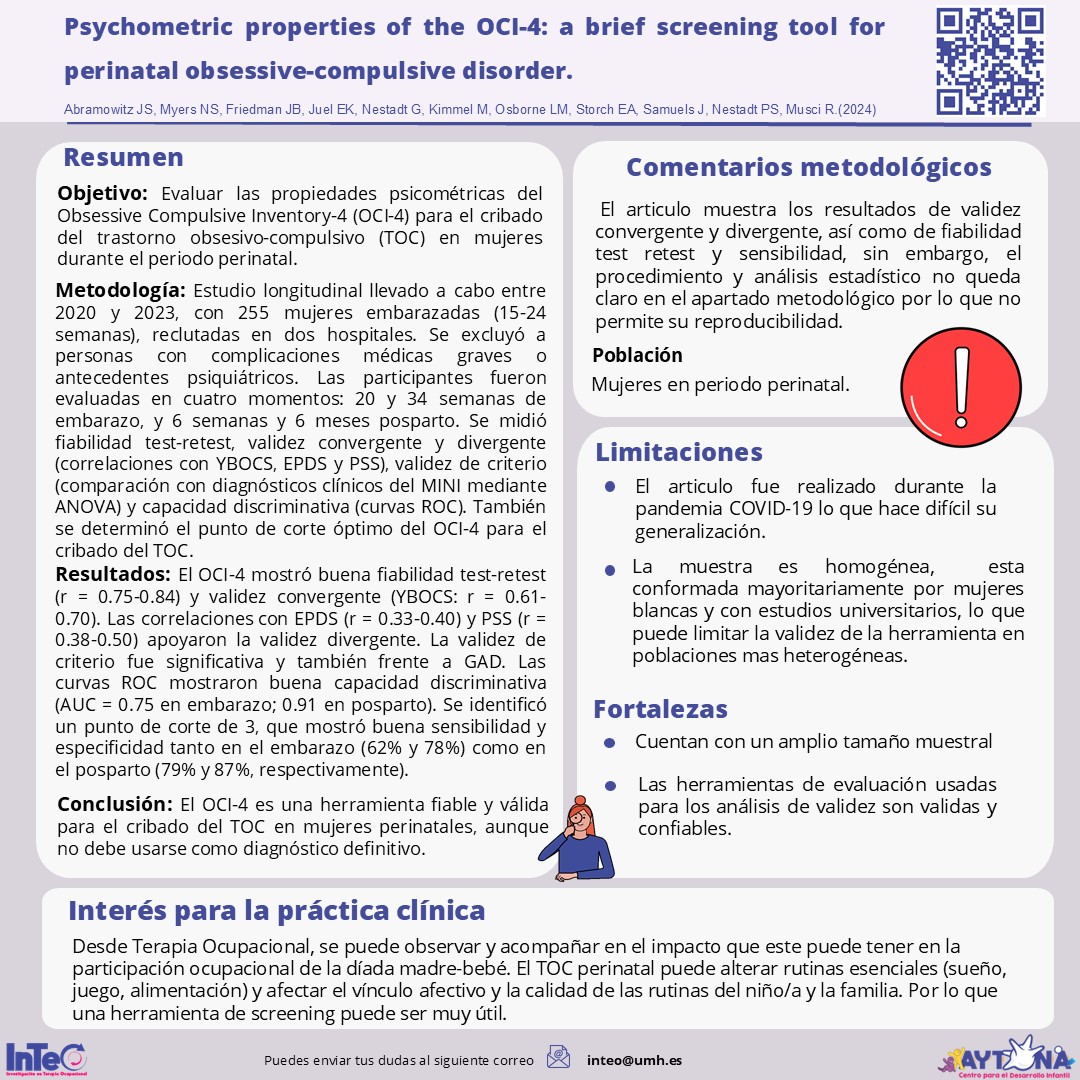
Objective: To evaluate the psychometric properties of the Obsessive-Compulsive Inventory-4 (OCI-4) as a screening tool for obsessive-compulsive disorder (OCD) in women during the perinatal period.
Methodology: A longitudinal study was conducted between 2020 and 2023, encompassing the COVID-19 pandemic. Two hundred and fifty-five pregnant women (15-24 weeks of gestation) were recruited from two hospitals. Individuals with serious medical complications or severe psychiatric history were excluded. Participants were assessed at four time points: 20 and 34 weeks of gestation, and at 6 weeks and 6 months postpartum. Test-retest reliability, convergent and divergent validity (correlations with the Yale-Brown Obsessive Compulsive Scale (YBOCS), Edinburgh Postnatal Depression Scale (EPDS), and Perceived Stress Scale (PSS)), criterion validity (comparison with clinical diagnoses from the MINI International Neuropsychiatric Interview using ANOVA), and discriminative capacity (using ROC curves) were assessed. The optimal OCI-4 cutoff point for OCD screening was also determined.
Results: The OCI-4 showed good test-retest reliability (r = 0.75–0.84) and convergent validity (YBOCS: r = 0.61-0.70). Correlations with the EPDS (r = 0.33-0.40) and PSS (r = 0.38-0.50) supported divergent validity. Criterion validity was significant (p < 0.001, η² = 0.14-0.49), and ROC curves showed good discriminatory capacity (AUC = 0.75 in pregnancy; 0.91 and postpartum. A cutoff point of 3 was identified, with a sensitivity of 62-79% and a specificity of 78-87%. Conclusion: The OCI-4 is a reliable and valid tool for screening for OCD in women during the perinatal period, although it should not be used as a definitive diagnosis. Methodological Comments
Determining the psychometric properties of an assessment tool is essential to ensure that it accurately, consistently, and appropriately measures what it was designed to measure. These properties are key indicators of the quality and usefulness of the tools in specific contexts and with particular populations, ensuring that the results obtained reliably and validly reflect the constructs being assessed.
To critically read an article evaluating psychometric properties, it is essential to consider the following aspects:
- Reliability: This assesses the consistency of the results obtained by the tool under different circumstances. It includes internal consistency (the degree of relationship between the items in the tool), test-retest reliability (stability in repeated measurements), inter-rater reliability (the degree of agreement between different evaluators), and the standard error of measurement (the inherent variability of the tool).
- Validity: This determines whether the tool actually measures the construct it intends to measure. It includes different types, such as content validity (the degree to which the items represent the construct domain), construct validity (factorial, cross-cultural, or hypothesis-testing), and criterion validity:
- Sensitivity: This indicates the tool’s ability to detect significant changes in the measured construct over time, ensuring its usefulness in clinical or research contexts.
Not all tools require the evaluation of all these psychometric properties, as their relevance depends on the purpose and context of the instrument’s use. In the article we analysed, test-retest reliability and criterion validity were addressed.
Following the structure of this article, we will clarify some aspects that we consider important in each section:
Abstract: This section should clearly define the objectives, methodology, and results of the study. Comparing it with the abstract we proposed, we observe that, although the study’s objective is clearly presented, it lacks relevant information about the context in which the research was conducted, since the study covered the period of the COVID-19 pandemic. Furthermore, it would be advisable to expand the methodology section, incorporating details about the tools used to assess validity, such as the YBOCS, the EPDS, and the PSS. Regarding the results, although they are mentioned in general terms, it would be useful to include statistical data.
Introduction: In this section, the authors should provide a clear contextualisation of the research topic and define the research question, which is usually expressed as an objective.
This article, in its introduction, defines and justifies the need to validate this tool for women in the perinatal period. The text describes the tool as a specific version of the “OCI Revise” scale. Therefore, attention should be paid to the validation article or the psychometric properties of the scale from which the Obsessive-Compulsive Inventory-4 (OCI-4) is derived.
As previously described, the study objective should be stated at the end of the introduction (which, in this case, is included in the article’s abstract). The authors do not write the objectives in the appropriate format; they should be described not only in the abstract but also at the end of the introduction. Instead of stating their objectives, they describe their hypotheses.
Methodology:
- Participants: The inclusion and exclusion criteria are well-defined. However, the sample has limitations that may affect the generalisability of the results. Most participants were women with a high level of education. The exclusion criteria left out women with psychiatric disorders and complicated pregnancies. Furthermore, the study was conducted during the COVID-19 pandemic, which could have affected the results.
In this section, it should be noted that this study reports the racial distribution of the sample as part of the participants’ sociodemographic characteristics. However, the use of race as a variable in mental health research does not reflect relevant biological factors. Including race can lead to misinterpretations or perpetuate inequality without providing useful information about the problem. Socioeconomic factors might have been a more informative alternative to racial categorisation.
- Definition and measurement of the main variables: Regarding the definition of the main variables, the authors adequately describe the scales used in the assessment (MINI, YBOCS, OCI-4, EPDS and PSS). Measurement was taken at three time points during the perinatal period: at 20 weeks of gestation, at 34 weeks of gestation, and at 6 weeks postpartum. Finally, a new measurement was taken at 6 months postpartum to verify the stability of the measurements. Clinical interviews were conducted via video calls using the Zoom platform, and self-report questionnaires were completed online through REDCap.
- Statistical Analysis: The statistical analysis performed was included in the results section, although it is usually included in the methodology section. The reliability of the OCI-4 was assessed using test-retest analysis, which is appropriate for evaluating the stability of the measurement over time. Pearson correlations were used because the measurement distribution was normal to assess convergent and divergent validity between the OCI-4 and other scales (YBOCS, EPDS, and PSS), which is appropriate. However, the tools used to calculate convergent and divergent validity are not clearly explained. Furthermore, analysis of variance (ANOVA) was performed to compare OCI-4 scores between groups with and without a diagnosis of OCD, and between groups with OCD and generalized anxiety disorder (GAD). ROC curve analysis was also performed to evaluate the sensitivity and specificity of the OCI-4 in detecting OCD. These analyses are appropriate and well-justified, as they allow for the evaluation of the OCI-4’s ability to discriminate between different groups.
Results: It would have been helpful if the authors had presented a clear description of the sociodemographic characteristics of the study population in a table. The results are inconsistent with the methodological explanation: we found subdivisions into groups, as well as a presentation of results that does not address the stated objective. This section specifies why internal consistency was not performed; however, this information should have been included in the previous section (Methodology). In the results subsection where they indicate convergent and discriminant validity, the authors do not seem to adequately differentiate between discriminant and divergent validity, since they use low correlations with the EPDS and PSS, thus evaluating the divergence of the tool (OCI-4) and not the discriminant validity as they state.
As we have indicated in the previous section, there is a lack of methodological information to be able to understand them properly.
Discussion: It is very important that in this section the authors compare the results obtained with those of other similar studies and attempt to explain the findings, as well as state the main limitations and strengths of the study..
It is very important that in this section the authors compare the results obtained with those of other similar studies and attempt to explain the findings, as well as state the main limitations and strengths of the study.On the other hand, this study presents several strengths: the sample size was large, and valid and reliable tools were used for comparison with the scale of interest.és.
Relevance to Clinical Practice
- 1. Concept, contextualisation, and importance for OTs
This article validates the OCI-4, scale, a brief, four-item questionnaire used to detect symptoms of Obsessive-Compulsive Disorder (OCD) in pregnant and postpartum women. Given that perinatal OCD is common but underdiagnosed, this tool could facilitate timely identification and referral to mental health services if needed.
From an occupational therapy perspective, one can observe and support the impact that perinatal obsessive-compulsive disorder (OCD) can have on the occupational participation of the mother-infant dyad..Perinatal OCD can disrupt essential routines (sleep, play, feeding) and affect the emotional bond and the quality of routines for both the child and the family..
Postpartum OCD can be confused with typical parental anxiety about raising a new child. It differs in the presence of intrusive obsessions and ritualised compulsions that interfere with daily functioning, sleep, and bonding.
- OCD:
- Presence of obsessions: intrusive, repetitive, irrational and difficult to control thoughts (e.g., constant fear of harming the baby).
- Compulsions: repetitive rituals to relieve anxiety (such as excessively checking if the baby is breathing).
- Significant interference in daily life and the mother-child bond.
- Normal anxiety:
- Reasonable concerns that are proportionate to the context (for example, occasionally checking if the baby is comfortable).
- There are no compulsive rituals or persistent intrusive thoughts.
- It does not seriously affect daily operations.
Obsessive-compulsive disorder (OCD) during pregnancy can cause the following complications:
- Women with a pre-existing OCD may experience an increase in the intensity of their symptoms.
- Increased anxiety and depression, affecting the mother’s emotional well-being.
- Difficulties bonding and emotionally connecting with the baby.
- The appearance of other symptoms such as gestational diabetes.
- Key messages (tips) with implications for clinical practice 1
Parenting and maternal mental health
- Perinatal OCD can affect the mother-baby bond, create rigid routines, intrusive thoughts, and increase parental stress. This directly impacts daily interactions and the shared responsibility of “being a mother” or the maternal role.
- Occupational Therapy, especially from a family-centred approach, recognises parental mental health as part of the environment that influences child development and participation (PEO/PEOP) (Bass et al., 2024).
The OCI-4 can be a useful tool for occupational therapists, as it may detect signs of dysfunction in maternal well-being that interfere with the occupational participation of the mother-infant dyad, but its use should be accompanied by an awareness of its limitations, and any positive results must be confirmed by a more comprehensive diagnostic evaluation Early intervention and occupational performance
- Obsessive–Compulsive Disorder (OCD) can affect daily routines with the baby, including feeding, sleep, caregiving, and play. Compulsive behaviours and avoidance may disrupt the child’s occupational environment. Occupational Therapy aims to restore meaningful participation in everyday activities. Early identification of perinatal OCD allows timely referral for multidisciplinary intervention while supporting occupational performance within the family context.
- From a responsive parenting and parental support perspective, understanding emotional challenges such as OCD enables professionals to provide non-judgemental support through interventions that respect the mother’s pace and promote her sense of competence and self-efficacy.
- Early identification helps prevent labelling and unnecessary pathologisation, facilitating informed and empathetic referrals that strengthen the therapeutic alliance and enhance parental confidence.
| Occupational Area | Example of the Impact of OCD | Occupational Therapy Support |
| Parenting | Excessive cleaning rituals before touching the baby | Designing more functional and sustainable daily routines |
| Shared Play | Avoidance of messy play (e.g., sand, paint) or environmental exploration | Gradual, safe sensorimotor activities to encourage participation |
| Sleep | Repeated checking of the sleeping baby | Safety strategies combined with healthy sleep routines |
| Feeding | Fear of bottle contamination or choking during feeding | Support in establishing safe and manageable feeding routines |
References
Bass, J. D., Marchant, J. K., de Sam Lazaro, S. L., & Baum, C. M. (2024). Application of the Person-Environment-Occupation-Performance Model: A Scoping Review. OTJR: Occupation, Participation and Health, 44(3), 521-540. https://doi.org/10.1177/15394492241238951
Occupational Therapy Practice Framework: Domain and Process—Fourth Edition | The American Journal of Occupational Therapy | American Occupational Therapy Association. (s. f.). https://doi.org/10.5014/ajot.2020.74S2001