
Article reference: Rocco K, Drobnyk W, Bruce S, Soumerai SB. Ayres Sensory Integration Therapy for a Child With Rett Syndrome: A Case Report. Clin Med Insights Pediatr. 2023;17:11795565231188939. doi: 10.1177/11795565231188939.
Link to the article: https://pubmed.ncbi.nlm.nih.gov/37529622/
Summary:
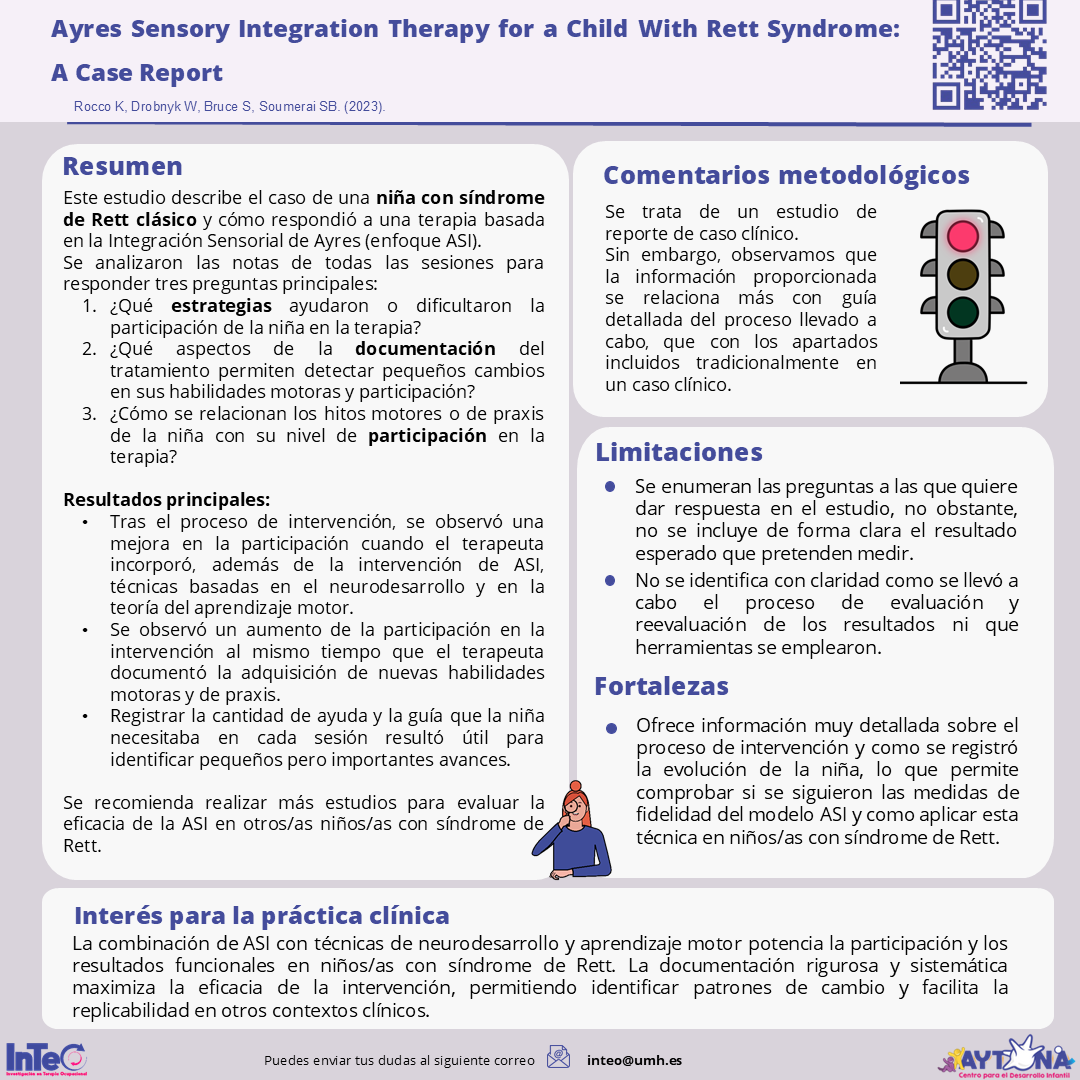
Rett syndrome is a neurodevelopmental disorder that causes severe difficulties in coordinating movements, repetitive hand movements, and sensory processing problems. There is currently no known treatment for these difficulties. This study describes the case of a girl with classic Rett syndrome and how she responded to therapy based on Ayres Sensory Integration (ASI approach), which was carried out in 36 one-hour sessions, three times a week.
The notes from all sessions were analysed to answer three main questions::
- What strategies helped or hindered the girl’s participation in therapy?
- What aspects of the treatment documentation allow the detection of small changes in her motor skills and participation?
- How do the girl’s motor or praxis milestones relate to her level of participation in therapy?
Following the intervention process, an improvement in participation was observed when the therapist incorporated, in addition to the ASI-based intervention, techniques based on neurodevelopment and motor learning theory, commonly used in children with neuromotor disorders. In addition, an increase in participation in the intervention was observed at the same time as the therapist documented the acquisition of new motor and praxis skills. The importance of activities that included lateral movements to improve bilateral coordination and balance, rotation games to promote trunk control and postural transitions, and the use of rhythm to facilitate the initiation or continuation of actions was highlighted. Recording the amount of help and guidance or support the child needed in each session was useful in identifying small but important advances. This scientific article has been classified with a red light in terms of scientific evidence because it is a clinical case. As it is a case study, the results should be interpreted with caution, as this type of design offers a limited level of evidence and does not allow causal relationships to be established or findings to be generalised. It would be advisable to conduct future studies with more methodologically robust designs, such as randomised clinical trials, to confirm and expand on these results.
Methodological comments:
The clinical case study allows for an in-depth analysis of the health situation and therapeutic process of an individual or small group, offering a detailed understanding of the phenomenon within its real context. This type of study is based on the systematic collection of information to achieve a comprehensive understanding, although the conclusions should be considered preliminary or exploratory, as the results that are effective for one person may not be generalisable to others. Clinical cases are often published because of their novelty, either due to the uniqueness of the condition described or the application of an innovative intervention (you can find more information on clinical cases at the following link).
There is no specific CASPe model guide for the critical reading process for this type of article. However, the CARE guide, available on the EQUATOR Network, can be used as a reference, as it provides guidelines for the proper presentation and reporting of clinical cases.
One of the initial steps when reading any scientific article is to review the conflicts of interest declared by the authors and the funding. In this case, we see that the authors declare that they have no potential conflicts of interest in this research. However, they indicate that they have received funding from two institutions (the Rett Syndrome International Foundation and the Michael and Susan Argyelan Educational Research Fund). A priori, due to the state nature of the grants, it seems that they may not be directly influencing the results. Even so, we must review the article cautiously, considering the possible biases that the funding may have influenced, both in the interpretation of the results and in the recommendations made.
This study has been published in a medical journal, which gives greater publicity and visibility to the intervention developed by occupational therapists, a practice that may be unknown to other professionals or fields. This publication not only helps to raise awareness of the approach and relevance of occupational therapists’ work in complex clinical contexts, but also fosters interdisciplinary exchange, promoting greater collaboration among healthcare professionals.
Before analysing the article text in depth, we recommend having prior knowledge about Sensory Integration and Rett Syndrome (you can find information about this condition at this link), especially if you are not familiar with these concepts.
One of the most valuable aspects of the work is the detailed description of the entire assessment and intervention process, which allows for verification of the actual application of the ASI model and ensures greater transparency and reproducibility. This level of detail facilitates practical application in real clinical contexts, providing useful tools for comparing procedures and using the ASI protocol as a reference. However, we found that the questions posed in the study do not fully align with the resolution and presentation of a clinical case, as they include information related to the methodology and procedure, generating a larger amount of data than what is typical in a traditional clinical case. In short, while the text could be very useful for understanding how the ASI technique was implemented in a classic Rett Syndrome case, upon reading it, it appears to be structured more like an application and procedural protocol than a classic clinical case. Furthermore, this clinical case belongs to a previous study that evaluated sensory integration intervention for improving functional reach and grasp in children with Rett Syndrome.
Having said that, some points we can comment on regarding the content of the article are the following:
- The title includes information about the intervention (Ayres sensory integration), the population (Rett Syndrome), and the type of study (clinical case), but does not specify the outcome they intend to measure.
- The summary provided by the authors lists the questions they want to answer with their research; however, they are quite general and lack information on how they will measure it.
- Regarding the novelty of the case, they explain that there is no prior evidence of treatment for cases of severe dyspraxia in Rett syndrome, and that there are also no studies that evaluate the effectiveness of sensory integration in this population.
- The case description is comprehensive, outlining the girl’s main difficulties, her characteristics, and past interventions. It also includes tables with further information about her initial condition.
- The study refers to the assessment carried out before and during the intervention, taking into account the initial and follow-up assessment notes. However, it does not explicitly mention that a reassessment was conducted at the end of the intervention, which limits the possibility of fully measuring the results. Furthermore, the tools used for the case assessment are not clearly specified: although the results obtained are detailed, it is not indicated how they were measured, nor whether standardised instruments or direct observation methods were used. It is important to note that, in this reading, we have not assessed all the content of the supplementary material provided by the authors, which could offer key information for understanding the process, Therefore, it is recommended that this material be reviewed in depth if the case is to be replicated or adapted in practice. In addition, the authors have not included the process diagram, as recommended by the CARE guidelines, which should illustrate the different phases of the process, especially the assessment and reassessment stages, thus facilitating a better understanding of the case. The same applies to the information related to the intervention and the results obtained; a great deal of data is provided in the supplementary tables; however, a clear summary of these sections is not included in the text.
- The authors state the limitations and strengths of the study. They identify that the collected notes are systematic and provide valuable information about the application of sensory integration in this case. They acknowledge that the results cannot be generalised, as it is based on only one specific case. Furthermore, they indicate a social desirability bias, since the treatment and the notes were taken by the same person. However, they attempt to minimise this bias through subsequent analysis by two occupational therapists who were not involved in taking the notes.
Following the methodological analysis, we believe this work provides valuable information about the intervention implemented and relevant insights into how to systematise information in similar cases within our clinical setting. It also addresses potential problems encountered during the intervention and identifies the most effective strategies for improving the participation of the girl with Rett syndrome. However, it is important to note that the presentation of the information is more akin to an intervention protocol than a clinical case report. Nevertheless, it can serve as a basis for generating hypotheses for future, more comprehensive studies.
Relevance to clinical practice
1. Concept (main topic of the article)
This study analyses the effectiveness of Ayres Sensory Integration Therapy (ASI) in an 8-year-old girl with Rett syndrome who required full assistance with activities of daily living. Thirty-six intervention sessions (three times per week) were conducted, integrating ASI, neurodevelopmental techniques, and motor learning strategies. The main objective was to analyse the impact of the intervention on the girl’s motor skill development and participation in her daily activities.
2. Contextualisation and importance for occupational therapists
This article provides a relevant example of occupational therapy intervention planning and implementation that could be extrapolated to other cases of Rett syndrome or other conditions with motor and sensory limitations. From an occupational perspective, analysing the factors that facilitate or interfere with active participation in daily life is essential, as outlined in the ICF model for childhood (WHO, 2007).
Factors that interfered with participation:
- Gross motor skills: lack of independence in basic postural transitions.
- Sensory processing: gravitational insecurity that limited dynamic activities.
- Fine motor skills: manual stereotypies that hindered functional gripping.
- Communication and cognition: absence of oral language, requiring augmentative systems.
- Medical problems: recurrent infections and gastrointestinal disorders that affected attendance at therapy.
Strategies that supported participation:
- Combined use of ASI, neurodevelopmental techniques and motor learning to facilitate active movement.
- Inclusion of rhythmic sensory input for anticipation and motor coordination.
- Games with lateral and rotary movement to improve bilateral coordination and postural control.
- Augmentative communication strategies and structured waiting times to promote motor ideation.
The study revealed significant progress in practice, mobility, and participation, reinforcing the idea that even small advances have an impact on quality of life (Dunst & Espe-Sherwindt, 2016; Schaaf & Mailloux, 2015).
3. Importance of documentation in progress
The article highlights the value of detailed clinical records for capturing subtle progress and informing decisions about adjusting the intervention. A record sheet with assistance scales (0 = full assistance, 5 = independence) was used, which allowed for:
- Identifying emerging milestones in practice and mobility.
- Documenting progressive advances in participation during postural transitions.
- Adjusting the intervention based on the child’s responses.
4. Key Messages (clinical tips for OT)
- Combining ASI with neurodevelopmental and motor learning techniques enhances functional outcomes in children with complex needs, promoting participation in meaningful contexts (Schaaf et al., 2018), (Blanche et al. 2016; Blanche, 2021).
- Rigorous and systematic documentation maximises the effectiveness of the intervention, allows for the identification of patterns of change, and facilitates replicability in other clinical contexts.
References:
- American Occupational Therapy Association. (2020). Occupational therapy practice framework: Domain and process (4th ed.). American Journal of Occupational Therapy, 74(Suppl. 2), 7412410010. https://doi.org/10.5014/ajot.2020.74S2001
Blanche, E. I., Giuffrida, C., Hallway, M., Edwards, B., Test, L. A., & otros. (2021).An evidence-based guide to combining interventions with sensory integration in pediatric practice. Routledge. - Blanche, E. I., Parham, L. D., & Chang, M. C. (2016). Combining approaches with sensory integration: A guide to neurodevelopmental treatment and other interventions. American Occupational Therapy Association Press.
Dunst, C. J., & Espe-Sherwindt, M. (2016). Family-centered practices in early childhood intervention. In B. Reichow et al. (Eds.), Handbook of Early Childhood Special Education (pp. 37–55). Springer. https://doi.org/10.1007/978-3-319-28492-7_3 - Schaaf, R. C., & Mailloux, Z. (2015). Clinician’s guide for implementing Ayres Sensory Integration®: Promoting participation for children with autism. American Journal of Occupational Therapy, 69(5), 6905187010. https://doi.org/10.5014/ajot.2015.696S04
Schaaf, R. C., Benevides, T., Mailloux, Z., Faller, P., Hunt, J., van Hooydonk, E., Freeman, R., Leiby, B., Sendecki, J., & Kelly, D. (2018). An intervention for sensory difficulties in children with autism: A randomized trial. Journal of Autism and Developmental Disorders, 48(6), 227–242. https://doi.org/10.1007/s10803-017-3344-0 - World Health Organization. (2007). International Classification of Functioning, Disability and Health: Children & Youth Version (ICF-CY). WHO Press.
Grupo InTeO. (2025, octubre 30). Ayres Sensory Integration Therapy for a Child With Rett Syndrome: A Case Report. TOcrítico – Habilidades Científicas en Terapia Ocupacional de InTeO. https://hacto.umh.es/2025/10/30/ayres-sensory-integration-therapy-for-a-child-with-rett-syndrome-a-case-report/
Este trabajo está bajo una Licencia Creative Commons 